
Choosing an audio mixer for beginners can be confusing when compact gaming consoles, podcast bundles, DJ boards, and traditional mixers all look similar. The right option depends on your microphones, devices, controls, and intended use.
We selected 10 accessible models for different starting points, from plug-and-play streaming to more flexible multi-input setups. Use the guide below to narrow the choices by connectivity, sound control, and upgrade potential.
Best 10 Audio Mixer for Beginners Picks for 2026
Best Beginner Gaming Mixer

- Four individual control channels
- XLR input with 48V phantom power
- RGB, voice changer, and monitoring
Best For: Beginner gaming and streaming setups
Best Compact Analog Mixer

- Six analog input channels
- D-PRE preamps with EQ and filters
- Rugged metal chassis
Best For: Learning traditional analog mixing
Best Large-Input Mixer
FULUODE CT-80S 8-Channel Mixer

- Eight channels for microphones and instruments
- Bluetooth, MP3, USB recording, and reverb
- Includes 48V phantom power
Best For: Karaoke, events, and small live performances
Best All-in-One Podcast Kit

- Includes mixer and 3.5mm condenser mic
- Four recordable and eight built-in effects
- Supports phones, PCs, and multiple platforms
Best For: Beginner podcasting and livestreaming
Compact Connectivity Pick

- Four channels with XLR and 6.35mm inputs
- USB recording plus Bluetooth and MP3 playback
- Compact design with +48V phantom power
Best For: Portable beginner recording, streaming, karaoke, and small DJ setups
Creator Bundle Pick

- Includes mixer, condenser microphone, and accessories
- Voice effects, noise reduction, and real-time tone controls
- Plug-and-play support for computers, phones, and tablets
Best For: Beginner streaming, podcasting, gaming, singing, and voice content
Effects-Focused Pick

- Includes voice changers, podcast modes, and sound effects
- Dual DSP noise reduction with 24-bit processing
- Supports computers and mobile multi-platform streaming
Best For: Interactive podcasting, live streaming, gaming, and voice content
Creative Streaming Hub

- Four programmable sound pads, voice changer, and adjustable reverb
- Noise reduction for clearer streaming and podcast audio
- Bluetooth background-audio input; wired monitoring required
Best For: Beginner PC streamers who want hands-on effects and voice controls
Portable Podcast Starter
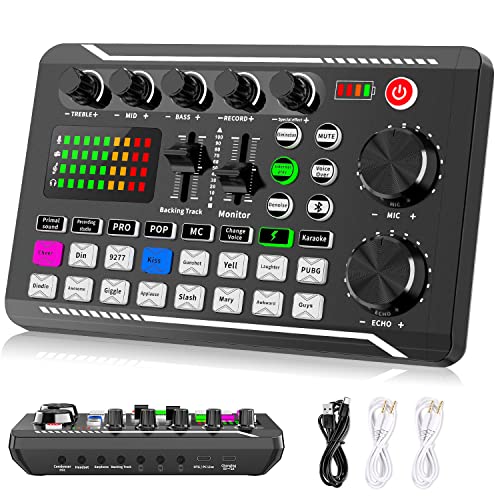
- Seven volume knobs and two faders for hands-on mixing
- 16 sound effects with voice-changing features
- Built-in 1200 mAh battery and Bluetooth accompaniment
Best For: Beginner podcasters and mobile live-streaming setups
Gaming Control Center

- 48V phantom power with XLR microphone support
- Game/chat balance, virtual 7.1 surround, and three EQ presets
- Eight voice effects and four customizable sound-profile buttons
Best For: Gamers who need detailed control across game, chat, and streaming audio
Best Beginner Gaming Mixer – FIFINE Ampligame SC3W
For beginners choosing an audio mixer for beginners, the FIFINE Ampligame SC3W offers a straightforward setup for gaming, streaming, and podcasting. Its four individual control channels, push faders, USB connectivity, XLR microphone input, and real-time monitoring make it easy to adjust several audio sources.
Best For: Beginner gamers and streamers who want hands-on controls, RGB lighting, and XLR microphone support.
Pros:
- Four independently adjustable control channels with physical faders
- XLR microphone input with built-in 48V phantom power
- Includes mute, monitoring, voice changer, and customizable sound features
- Supports dual-PC and multiple-device setups
Cons:
- Designed primarily for gaming, streaming, and voice-focused use
- Requires corded power
The SC3W is a practical starting point if you want beginner-friendly controls and entertainment features rather than a traditional studio mixer. Its compact 8-ounce design also suits smaller desks.
Best Compact Analog Mixer – Yamaha MG06
The Yamaha MG06 is a solid audio mixer for beginners who want to learn traditional analog mixing. It provides six inputs, studio-grade D-PRE preamps, three-band EQ, high-pass filters, and one-knob compressors in a compact, rugged chassis.
Best For: Beginners working with microphones and instruments for recording, lectures, rehearsals, or small performances.
Pros:
- Six-channel layout offers room for multiple audio sources
- D-PRE preamps are designed for natural bass and smooth highs
- Three-band EQ and high-pass filters help shape and clean up audio
- Rugged powder-coated metal chassis
Cons:
- No USB connectivity
- Does not include built-in Bluetooth, effects, or recording features
The MG06 favors dependable analog control over streaming-focused extras. It is a good fit if learning gain, EQ, filtering, and compression matters more than direct computer integration.
Best Large-Input Mixer – FULUODE CT-80S 8-Channel Mixer
The FULUODE CT-80S is an audio mixer for beginners who need many inputs and built-in entertainment functions. This eight-channel board combines microphone and instrument connections with 48V phantom power, reverb, Bluetooth 5.0, an MP3 player, USB recording, and an LED display.
Best For: Home karaoke, small bands, conferences, campus activities, and live music setups needing flexible wired and wireless inputs.
Pros:
- Eight-channel design accommodates multiple microphones and instruments
- Includes 48V phantom power for compatible microphones
- Built-in Bluetooth 5.0, MP3 playback, USB recording, and reverb
- Ultra-thin design with a large LED display
Cons:
- At 3.3 kg, it is less portable than smaller beginner mixers
- Uses a 110V American plug
- The large feature set may take longer to learn
The CT-80S suits beginners who expect their setup to grow beyond a single microphone. Its numerous inputs and built-in playback tools are useful for group events, though its size and feature count make it less minimal than a basic starter mixer.
Best All-in-One Podcast Kit – MAONO S1 Podcast Mixer Bundle
The MAONO S1 bundle is an accessible audio mixer for beginners who want a ready-to-use podcast or streaming setup. It includes the mixer, a 3.5mm condenser microphone, tripod, cable, windscreen, and effects, with support for smartphones, computers, and multiple streaming devices.
Best For: New podcasters, livestreamers, and creators who need a bundled microphone and mixer for voice-focused content.
Pros:
- Includes microphone, tripod, cable, windscreen, and mixer
- Offers four recordable and eight built-in sound effects
- Supports up to two people, four devices, and four platforms simultaneously
- Provides voice changing, reverb, noise reduction, and real-time monitoring
Cons:
- Uses 3.5mm microphone input and does not support phantom power
- Guitars and keyboards require an additional 6.35mm-to-3.5mm adapter
- Phones without a 3.5mm jack need an OTG adapter
The MAONO bundle removes much of the guesswork from starting a podcast or livestream. It is especially convenient for voice creators, but users planning to connect professional XLR microphones or instruments should consider its input limitations.
Compact Connectivity Pick – 4-Channel Bluetooth Mixer
If you want an audio mixer for beginners that can handle microphones, instruments, Bluetooth playback, and computer recording, this compact four-channel model is a practical starting point. Its straightforward controls, USB interface, and +48V phantom power support make it flexible for home recording, streaming, karaoke, and small events.
Best For: Beginners building a portable setup for podcasting, live streaming, home recording, karaoke, or small DJ sessions.
Pros:
- Supports XLR and 6.35mm inputs for microphones, guitars, bass, and keyboards.
- Built-in USB audio interface enables plug-and-play recording and live streaming.
- Bluetooth and USB flash-drive MP3 playback add convenient music sources.
- Compact 7.87-by-6.7-by-1.57-inch design is easy to transport.
Cons:
- Bluetooth supports input only, not wireless audio output.
- It uses corded power, so it is not fully battery portable.
- Effects and controls are relatively simple compared with creator-focused sound cards.
This is a well-rounded choice for first-time users who want conventional mixer connections without a complicated setup. It is especially appealing when portability and basic USB recording matter more than extensive vocal effects.
Creator Bundle Pick – TENLAMP G10 Mixer with Mic
For beginners who want an audio mixer for beginners that includes the core recording gear, the TENLAMP G10 bundle keeps setup simple. It combines a two-channel mixer, condenser microphone, and accessories with noise reduction, voice effects, and plug-and-play compatibility for streaming and content creation.
Best For: New streamers, podcasters, gamers, singers, and voice creators who want an all-in-one microphone and mixer package.
Pros:
- Includes a condenser microphone and essential accessories in one package.
- Offers bass, treble, reverb, pitch adjustment, voice changing, and sound effects.
- Supports PC, phone, and tablet use across Windows, Mac, iOS, and Android.
- Follow Singing mode lets the performer monitor the original track while mixing voice and music for the audience.
Cons:
- Only two channels may limit larger multi-source setups.
- Its creative effects may be more than users need for straightforward instrument mixing.
- Battery-powered operation may require attention to charging and runtime.
The G10 is a convenient entry point when buying a complete creator setup is more important than choosing every component separately. Its effects-oriented design suits interactive broadcasts and singing particularly well.
Effects-Focused Pick – SINWE F988 Live Sound Card
The SINWE F988 is an audio mixer for beginners who are more interested in live interaction than traditional studio mixing. Its four-channel sound card provides built-in sound effects, voice changers, podcast modes, Bluetooth accompaniment, and connections for computers, phones, and tablets.
Best For: Beginners making podcasts, live streams, gaming content, voice recordings, or music sessions with interactive effects.
Pros:
- Provides 16 fixed background sound effects, seven podcast and recording modes, and four voice-changer modes.
- Dual DSP noise reduction and 24-bit processing are designed for clear voice capture.
- Can connect with Windows, Mac, iPad, and smartphones; up to three mobile phones are supported for multi-platform streaming.
- Compact 4.72-by-7.67-by-1.96-inch body is easy to fit into a desktop setup.
Cons:
- The product is centered on a 3.5mm headphone output rather than a broad range of speaker outputs.
- Adapters may be required for iPad and iPhone connections.
- The supplied warranty details are inconsistent, listing both 12 months and a manufacturer warranty of 90 days.
This model makes sense for users who want buttons and effects to shape a live broadcast quickly. Those seeking a conventional mixer for multiple instruments and powered speakers may find its sound-card-oriented connection layout less suitable.
Creative Streaming Hub – PUPGSIS T12S Audio Mixer
The PUPGSIS T12S is an audio mixer for beginners who want streaming-focused controls without relying on software. It combines a 1/4-inch TRS microphone input, noise reduction, reverb, programmable sound pads, voice changing, and Bluetooth background-audio input in one compact control hub.
Best For: Beginner PC streamers, gamers, and podcasters who want built-in effects and quick hands-on controls.
Pros:
- Includes four programmable sound-effect pads, a voice changer, and adjustable reverb.
- Noise reduction helps reduce background hum, fan noise, and other unwanted sounds.
- Bluetooth can stream music, backing tracks, or sound effects into the mixer.
- Designed as an all-in-one hub for gaming, podcasting, and live streaming.
Cons:
- Works with XLR microphones through a 1/4-inch TRS-to-XLR cable, not USB microphones.
- Bluetooth is input-only, so wireless headphones and wireless microphone output are not supported.
- The required TRS-to-XLR cable must be added separately unless obtained through the promotional offer.
For beginners who prioritize fun stream effects and simple physical controls, the T12S offers a feature-rich starting point. Check the microphone and cable requirements before buying, especially if your current microphone is USB.
Portable Podcast Starter – Facmogu F998 Live Sound Card
The Facmogu F998 is an audio mixer for beginners building a portable podcast, karaoke, gaming, or live-streaming setup. Its straightforward controls include seven independent volume knobs, two faders, noise reduction, Bluetooth accompaniment, and 16 built-in sound effects.
Best For: New podcasters and casual creators who want a compact, battery-equipped sound card with simple live effects.
Pros:
- Offers seven independent volume adjustments and two fader controls.
- Includes 16 sound effects, voice-changing features, and breathing-light feedback.
- Built-in 1200 mAh battery supports portable use without frequent power connections.
- Supports up to two people and three devices for simultaneous live broadcasting.
Cons:
- The listed specifications identify it as a one-channel unit.
- Bluetooth is intended for wireless accompaniment rather than a general wireless monitoring setup.
- The broad compatibility and feature set may be more than needed for a basic single-microphone recording setup.
The F998 is a practical entry-level choice when portability and quick access to effects matter. Its compact design, battery, and plug-and-play positioning make it especially appealing for beginners moving between streaming or recording locations.
Gaming Control Center – FIFINE SC8 Gaming Audio Mixer
The FIFINE SC8 is an audio mixer for beginners who want more control over game, chat, microphone, and background audio. It adds XLR microphone support with 48V phantom power, multi-platform connections, game/chat balancing, virtual 7.1 surround sound, voice effects, and customizable sound profiles.
Best For: Beginner and enthusiast gamers who want a versatile mixer for PC, PlayStation, Switch, mobile, and streaming use.
Pros:
- Supports XLR microphones with 48V phantom power and a Dynamic/Condenser toggle.
- Provides dedicated game/chat balancing, three EQ presets, and virtual 7.1 surround sound.
- Includes eight voice-changing effects and four customizable buttons for saved audio pieces or profiles.
- Offers optical AUX, 3.5mm AUX-in, and USB-C plug-and-play connectivity.
Cons:
- It is not compatible with USB microphones and supports XLR or 6.35mm microphones instead.
- An XLR cable is not included.
- Its many gaming-focused controls may be unnecessary for simple voice recording.
The SC8 stands out for beginners who expect their setup to grow beyond basic streaming. It provides extensive gaming and chat control, but buyers should budget for a suitable shielded XLR cable and confirm their microphone type first.
How We Picked the Best Audio Mixer for Beginners
We focused on mixers that are approachable for first-time users while covering common needs such as gaming, livestreaming, podcasting, DJing, and basic music work. Our comparison considers input count, microphone compatibility, USB or Bluetooth connectivity, monitoring controls, built-in effects, portability, and whether the mixer includes a microphone or other useful accessories.
Beginner-friendly design matters as much as specifications. Clearly labeled controls, dedicated volume adjustments, simple connections, and practical monitoring features can reduce setup time and make it easier to learn basic gain and level management.
Quick Comparison
| Best For | Look For | Likely Fit |
|---|---|---|
| Gaming and streaming | USB connectivity, headphone monitoring, sound effects, voice controls | FIFINE SC3W, PUPGSIS, FIFINE SC8 |
| Podcasting | Microphone support, independent level controls, easy computer connection | MAONO, TENLAMP, SINWE |
| Music and instruments | Multiple inputs, reliable gain controls, phantom power where needed | Yamaha MG06, FULUODE |
| DJing and casual playback | Bluetooth, USB MP3 playback, reverb, compact layout | 4-Channel DJ Mixer, Facmogu F998 |
Key Buying Factors for an Audio Mixer for Beginners
Inputs and Microphone Compatibility
Count the sources you plan to connect now, then leave room for modest growth. A single headset or USB-oriented setup needs fewer inputs than a podcast with multiple microphones or a music setup with instruments. Check whether the mixer accepts XLR, 3.5mm, or line-level connections, and remember that USB microphones may not connect directly to traditional analog mixers.
Phantom Power and Gain Control
Condenser microphones often require 48V phantom power, while many dynamic microphones do not. Independent gain and volume controls help prevent clipping and make different sources easier to balance. Use phantom power only when your connected equipment supports it.
Computer, Phone, and Playback Connections
USB is useful for sending audio to a computer, while Bluetooth and USB MP3 playback are convenient for background music or casual use. Confirm the mixer’s intended connection direction: some Bluetooth features receive music but do not transmit your microphone mix wirelessly.
Monitoring and Effects
A headphone output with separate monitoring control is valuable for live work because it lets you hear the mix without relying on speakers. Voice changers, reverb, sound pads, and surround-style processing can be entertaining, but they should not replace clean inputs and dependable level control.
Who Should Buy Which Audio Mixer for Beginners?
Choose a gaming-focused model if you mainly stream from a PC and want quick access to mute, effects, voice controls, or multiple chat sources. A podcast bundle is more convenient when you need a microphone and want to start recording with fewer extra purchases.
Choose the Yamaha or another conventional multi-input mixer if your priority is straightforward control over microphones, instruments, or line-level sources. Models with Bluetooth, USB playback, and reverb make more sense for casual DJing, karaoke, announcements, and general entertainment. Before buying, verify included cables, operating-system compatibility, microphone requirements, and the number of sources you need to monitor simultaneously.