
The best audio mixers with USB interface combine hands-on level control with straightforward computer connectivity, making them useful for podcasts, livestreams, music, and home studios.
This roundup compares 10 options across digital and analog designs, from compact beginner mixers to flexible multi-input systems. Consider channel count, routing, phantom power, effects, and monitoring features before choosing.
Best 10 Audio Mixers with USB Interface Picks for 2026
Best Tablet-Controlled Mixer
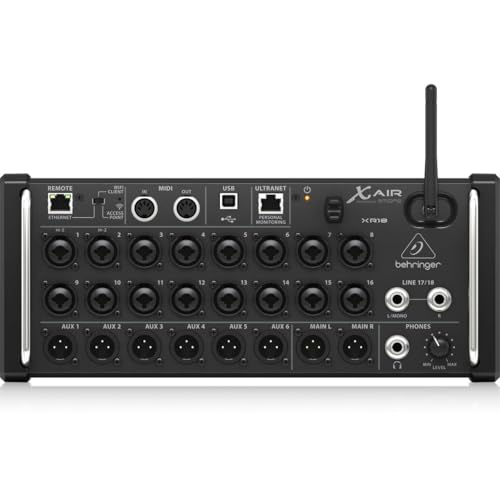
- 18-channel digital mixer with 18 x 18 bidirectional USB
- 16 programmable MIDAS mic preamps
- Built-in Wi-Fi for iPad and Android control
Best For: Live bands, studios, and multichannel tablet-controlled setups
Best for Gaming Streams

- XLR input with 48V phantom power
- Independent mic, line, headphone, and output controls
- Built-in sound effects, voice changing, and RGB lighting
Best For: Beginner streamers using an XLR microphone
Best Analog USB Mixer

- 12-input, 2/2-bus analog mixer
- XENYX preamps and compressors
- British-style three-band EQs with USB connectivity
Best For: Home studios and small hands-on analog mixing setups
Best Compact Streaming Mixer

- Six-channel mixer with USB audio interface
- Loopback, DSP effects, and mute button for streaming
- Two phantom-powered mic inputs and included software
Best For: Livestreamers, podcasters, and compact desktop setups
Best All-Around Mixer

- 12 inputs with four XENYX mic preamps
- Four one-knob compressors and built-in effects
- Stereo USB interface with included software
Best For: Home recording, podcasting, and small live setups
Best Budget Wireless Mixer

- Eight channels with XLR and 1/4-inch inputs
- Bluetooth streaming and USB-A MP3 playback
- Phantom power, DSP effects, and steel chassis
Best For: Karaoke, DJ use, and casual live performances
Best for Comfort

- Eight-input analog mixer for streaming and recording
- Stereo USB interface for computer or mobile use
- Mixes PC and gaming audio into the stream
Best For: Streaming, podcasting, and simple recording setups
Feature-Packed Pick

- Six channels with four XLR inputs and 48V phantom power
- USB, Bluetooth, and USB-drive playback support
- 16 DSP effects and 3-band EQ for flexible mixing
Best For: Karaoke, streaming, recording, and small live setups
Compact Classic
Behringer XENYX 302USB Mini Mixer
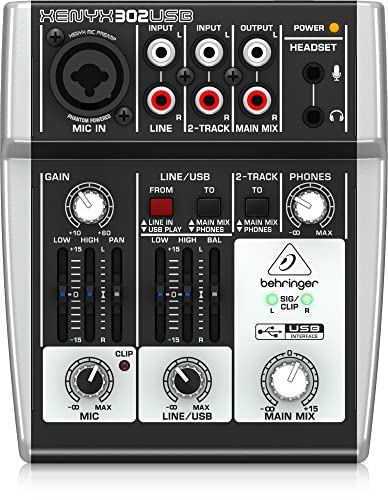
- Compact five-input design for small workspaces
- Stereo USB/audio interface for direct computer connection
- XENYX mic preamp with phantom power
Best For: Podcasts, streaming, and compact home studios
Live-Control Choice
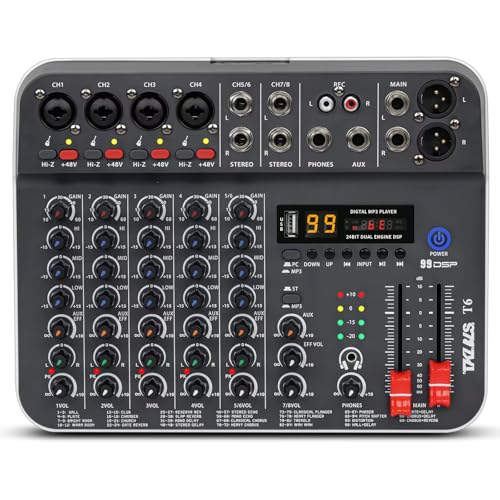
- Six channels with combo XLR/line inputs
- Bluetooth, MP3, and USB-drive playback
- REC OUT, digital delay, and 48V phantom power
Best For: Live shows, conferences, karaoke, and livestreaming
Best Tablet-Controlled Mixer – Behringer X AIR XR18
For buyers seeking audio mixers with usb interface capability for live sound or studio work, the Behringer X AIR XR18 combines 18 inputs with an 18 x 18 bidirectional USB connection. Its tablet control, programmable MIDAS preamps, and built-in Wi-Fi router make it a flexible option when hands-on hardware controls are not essential.
Best For: Live bands, studios, and users who want tablet-based control with extensive USB recording and routing.
Pros:
- 18-channel mixer with an 18 x 18 bidirectional USB audio interface.
- Includes 16 fully programmable MIDAS-designed mic preamps.
- Built-in tri-mode Wi-Fi router supports direct tablet operation.
- Supports iPad and Android tablet control.
Cons:
- Operation is centered on iPad or Android tablets rather than a traditional control surface.
- Its 18-channel feature set may be more than a simple home setup needs.
The XR18 is a strong choice when you need high input capacity, remote control, and multichannel USB recording in one compact digital mixer. Its feature set is particularly suited to more involved live or studio workflows.
Best for Gaming Streams – FIFINE Ampligame SC3
The FIFINE Ampligame SC3 is a compact choice among audio mixers with usb interface support for gaming, streaming, and online content. It provides an XLR mic input with 48V phantom power, separate level controls, mute and monitor buttons, and built-in sound and voice effects.
Best For: Beginner streamers and gamers using an XLR microphone with a computer-based setup.
Pros:
- XLR microphone input and built-in 48V phantom power support condenser microphones.
- Individual controls adjust microphone, line-in, headphone, and line-out levels.
- Includes four customizable sound-effect buttons, voice changing modes, and auto-tune options.
- Works with Mac OS and Windows and supports two-PC configurations.
Cons:
- Not compatible with USB microphones.
- An XLR cable is not included.
- The feature set is aimed at one-mic streaming rather than larger multi-input mixing.
With straightforward controls and streamer-focused effects, the SC3 is designed for accessible live production. It is best matched with an XLR microphone and a computer setup rather than a general-purpose studio or band mixer.
Best Analog USB Mixer – Behringer XENYX 1204USB
The Behringer XENYX 1204USB is a practical option for shoppers comparing audio mixers with usb interface connectivity and preferring a conventional analog workflow. It pairs a low-noise, high-headroom design with XENYX mic preamps, compressors, British-style three-band EQs, and USB connectivity.
Best For: Home studios, small productions, and users who want hands-on analog mixing with USB audio connectivity.
Pros:
- Provides 12 inputs and a 2/2-bus analog mixer layout.
- Features XENYX mic preamps and compressors.
- Includes British-style three-band EQs for a warm, musical sound.
- Designed for low noise and high headroom.
Cons:
- It uses a traditional analog control layout rather than tablet-based digital mixing.
- The supplied specifications identify USB connectivity but do not detail multichannel USB routing.
The 1204USB makes sense when tactile knobs, faders, and analog EQ matter more than advanced digital automation. It offers useful input capacity for smaller setups while retaining a direct USB connection to a computer.
Best Compact Streaming Mixer – Yamaha AG06MK2
The Yamaha AG06MK2 is a compact pick among audio mixers with usb interface functionality, built around live streaming, loopback, and simple computer recording. It offers six channels, two phantom-powered microphone inputs, onboard DSP effects, a mute button, and control through Yamaha’s AG Controller software.
Best For: Livestreamers, podcasters, and creators who need a small mixer with USB interface features and loopback.
Pros:
- Combines a six-channel mixer with a USB audio interface.
- Includes DSP effects, loopback, and a dedicated mute button for streaming.
- Two microphone inputs provide phantom power for condenser microphones.
- Includes Cubase AI and WaveLab Cast software.
Cons:
- Its six-channel design offers less input capacity than larger mixers.
- It uses a wired USB connection rather than integrated wireless control.
- The compact layout may provide fewer physical controls for complex mixes.
The AG06MK2 is a focused streaming interface rather than a large live-sound console. Its compact form, loopback function, DSP, and included software make it well suited to creators who value a simple desktop workflow.
Best All-Around Mixer – Behringer XENYX X1204USB
If you need audio mixers with USB interface for recording, podcasting, or live mixing, the Behringer XENYX X1204USB combines 12 inputs with four mic preamps, compressors, British-style EQ, built-in effects, and a stereo USB connection. It is a feature-rich choice for users who want both hands-on analog controls and direct computer connectivity.
Best For: Home recording, podcasting, vocal processing, and small live setups that need multiple inputs and onboard effects.
Pros:
- Four phantom-powered XENYX mic preamps and four one-knob compressors.
- Built-in stereo USB/audio interface for direct computer connection.
- Includes a 24-bit multi-FX processor, British-style three-band EQs, and recording software.
- 12-input design offers more expansion room than compact mixers.
Cons:
- Its larger feature set may be more than needed for simple two-channel setups.
- Requires corded power and is specified for 240V AC.
The X1204USB is a versatile option when channel count, vocal control, and integrated effects matter. Its USB interface makes computer recording straightforward, while the analog controls support live, hands-on mixing.
Best Budget Wireless Mixer – Pyle PMXU83BT
Among audio mixers with USB interface, the Pyle PMXU83BT emphasizes convenient streaming and basic live control. This eight-channel mixer adds Bluetooth playback, a USB-A MP3 player, DSP effects, phantom power, and both XLR and 1/4-inch inputs in a compact steel chassis.
Best For: Karaoke, DJ use, live gigs, and users who want wireless music playback alongside microphone and line inputs.
Pros:
- Bluetooth enables wireless music streaming from a smartphone.
- Eight channels include XLR and unbalanced 1/4-inch inputs.
- Provides +48V phantom power, three-band EQ, LED peak indicators, and DSP effects.
- Rugged steel chassis and 100V–240V power supply support portable use.
Cons:
- The supplied notes identify a 16-bit DSP processor rather than a higher-resolution effects specification.
- Its USB feature set is described with a USB-A MP3 player and audio-interface connectivity, so users should confirm their preferred computer workflow.
The PMXU83BT is a practical value-oriented mixer for performances and entertainment setups. Bluetooth and the USB-A player add convenience, while phantom power and multiple input types cover common microphone and stereo-source needs.
Best for Comfort – Behringer XENYX 802S
Behringer XENYX 802S Premium Analog 8-Input Mixer with USB Streaming Interface
Check Price On AmazonThe Behringer XENYX 802S is a compact choice for audio mixers with USB interface, designed around streaming, podcasting, and recording. Its analog controls support direct mixing of PC or gaming audio into the streaming output, while the stereo USB interface connects to a computer or mobile device.
Best For: Streamers, podcasters, and creators who need simple analog mixing with computer or mobile-device audio.
Pros:
- Stereo USB audio interface connects to a computer or mobile device.
- Supports direct mixing of PC and gaming sounds into the streaming output.
- Analog mixing and equalization provide hands-on control.
- Offers XLR, TRS, and RCA output connections.
Cons:
- With eight inputs, it has less capacity than larger multi-channel mixers.
- The supplied notes do not specify onboard compressors, effects, or phantom-power features.
The XENYX 802S keeps the workflow focused on streaming and straightforward recording. It is a sensible fit when you want analog control and computer or mobile connectivity without prioritizing a large effects section.
Feature-Packed Pick – 6-Channel Bluetooth DSP Mixer
This 6-channel console is a flexible choice among audio mixers with usb interface, combining USB playback, Bluetooth streaming, four XLR inputs, phantom power, and built-in DSP effects. It suits users who need hands-on control for karaoke, streaming, recording, or small live setups.
Best For: Karaoke, live performance, streaming, and users who want Bluetooth playback plus onboard reverb effects.
Pros:
- Six input channels with four XLR inputs and 1/4-inch connections
- USB interface supports playback from a USB drive or MP3 source
- Bluetooth streaming and 16 built-in DSP effects
- 48V phantom power and 3-band EQ for compatible microphones and instruments
Cons:
- Its analog controls may require careful setup to avoid operation-related sound issues
- Manufacturer warranty is listed as 90 days
This model offers a broad feature set for the price-conscious buyer, especially if wireless playback and vocal effects matter. Its multiple inputs make it more adaptable than a basic compact mixer, though first-time users may need to spend time learning the controls.
Compact Classic – Behringer XENYX 302USB Mini Mixer
The Behringer XENYX 302USB is a compact option for shoppers comparing audio mixers with usb interface for podcasting, home recording, and streaming. Its five-input design, USB connectivity, and XENYX microphone preamp provide essential mixing functionality in a small footprint.
Best For: Podcasts, simple streaming stations, voice recording, and space-constrained home studios.
Pros:
- Ultra-compact design measures 5.4 by 4.5 by 1.8 inches
- Built-in stereo USB/audio interface connects directly to a computer
- Includes a phantom-powered XENYX microphone preamp
- Can run through USB or the included external power adapter
Cons:
- Five-input layout is less expansive than many six-channel mixers
- Its 2-band EQ offers less tone control than models with 3-band EQ
This is the most space-efficient choice in the group and focuses on straightforward computer-based audio work. Choose it when a small desk footprint and a dependable USB connection are more important than extensive effects, Bluetooth, or numerous inputs.
Live-Control Choice – TKLBLS T6 6-Channel USB Mixer
The TKLBLS T6 is a practical pick among audio mixers with usb interface for live shows, conferences, KTV, and streaming. It combines six inputs, combo XLR/1/4-inch jacks, Bluetooth and USB playback, individual channel controls, and a dedicated REC OUT connection.
Best For: Live vocals, conferences, livestreams, karaoke, and users who want independent channel balancing.
Pros:
- Six channels with independent gain and EQ controls
- Combo XLR/1/4-inch inputs support microphones and instruments
- USB drive, MP3, and Bluetooth playback options
- Dedicated REC OUT jack and built-in digital delay processor
Cons:
- Unpowered design requires a corded power source
- Channel tone shaping is described with high and low EQ controls rather than a fuller multi-band EQ
The T6 emphasizes flexible live operation, with sliding faders, playback options, and recording output in a relatively compact enclosure. It is a strong fit for users who need hands-on control across several sources without moving to a larger console.
How We Picked These Audio Mixers with USB Interface
We focused on mixers that combine physical audio controls with USB connectivity for recording, streaming, playback, or live production. The selection covers compact podcast and gaming models, traditional analog mixers, and larger digital systems. We also considered input capacity, microphone preamps, phantom power, onboard effects, monitoring options, wireless features, and how easily each mixer fits a typical home or mobile setup.
Because needs vary widely, the list includes both simple plug-and-play choices and more capable consoles. A mixer with more channels is not automatically better if it adds controls or routing you will not use.
Quick Comparison
| Best For | What to Prioritize | Typical Suitable Type |
|---|---|---|
| Solo podcasts and streaming | Simple USB connection, microphone gain, monitoring | Compact USB mixer |
| Gaming and voice chat | Fast level controls, loopback, headphone output | Gaming-focused mixer |
| Small bands or events | More inputs, phantom power, EQ, effects | Analog multi-channel mixer |
| Home recording | Clean preamps, reliable USB playback and recording | USB recording mixer |
| Complex live setups | Flexible routing, remote control, scene recall | Digital mixer |
Key Buying Factors for Audio Mixers with USB Interface
Inputs and Channel Layout
Count the microphones, instruments, phones, and playback devices you expect to connect at the same time. XLR inputs are important for microphones, while combo or line inputs accommodate instruments and other sources. Leave some capacity for future expansion.
USB Routing and Compatibility
USB functionality differs considerably. Some mixers send a basic stereo mix to a computer, while others provide multitrack recording or flexible playback routing. Check operating-system compatibility, USB connection type, and whether the mixer supports the workflow used by your recording or streaming software.
Phantom Power and Microphone Preamps
Condenser microphones generally need 48V phantom power. Verify that the mixer supplies it in the way your microphones require. Preamps should offer enough clean gain without excessive noise, especially for spoken-word recording.
Monitoring, Effects, and Controls
Headphone monitoring, independent output control, mute functions, EQ, compression, and reverb can make production easier. Built-in effects are useful for live work, but they may matter less for users who prefer software plug-ins.
Analog Versus Digital Design
Analog mixers are usually quicker to understand and operate directly. Digital models can provide deeper routing, presets, remote control, and more processing, but they often require a steeper learning curve and a tablet or computer for full setup.
Who Should Buy Which Audio Mixers with USB Interface?
Choose a Compact Mixer for Simple Setups
Solo creators, streamers, and beginners should prioritize a small mixer with accessible gain, volume, and headphone controls. Fewer inputs can reduce clutter and make troubleshooting easier.
Choose a Multi-Channel Analog Mixer for Live Audio
Small bands, venues, DJs, and event users benefit from multiple mic and line inputs, channel EQ, phantom power, and onboard effects. Confirm that the USB connection supports the recording or streaming function you need.
Choose a Digital Mixer for Flexible Production
Users managing several performers, remote-controlled setups, or repeatable live scenes should consider a digital mixer. These models are best when routing flexibility and recallable settings outweigh the desire for immediate, hardware-only control.
Check the Complete Signal Path
Before buying, confirm the microphones, cables, powered speakers, headphones, computer, and software will work together. The right audio mixer is the one that supports your actual sources and workflow without requiring unnecessary adapters or upgrades.