
Bluetooth support can make a Linux desktop far more convenient, but adapter compatibility, kernel support, range, and connection stability vary widely between USB dongles.
We selected 10 Bluetooth adapters for Linux that cover everyday peripherals, newer Bluetooth standards, long-range setups, and combination Wi-Fi upgrades.
Best 10 Bluetooth Adapters for Linux Picks for 2026
Linux Classic
Panda Bluetooth 4.0 Nano Adapter

- Bluetooth 4.0 LE and EDR
- Supports many Linux distributions
- Advertised range up to 80 feet
Best For: Linux PCs needing basic Bluetooth connectivity
Windows Only
TP-Link UB500 Bluetooth 5.4 Adapter

- Bluetooth 5.4, EDR, and BLE
- Very small nano USB design
- Explicitly does not support Linux
Best For: Windows PCs, not Linux systems
Linux Ready
Cudy BU530 Bluetooth 5.3 Adapter

- Explicit Linux compatibility
- Bluetooth 5.3 with lower-latency streaming
- Tiny 2-gram USB-A design
Best For: Linux desktops and laptops needing modern Bluetooth
Best Compact Pick
ASUS USB-BT600 Bluetooth 6.0 Adapter

- Bluetooth 6.0 with BLE
- Connects up to seven devices
- Compact Linux-compatible design
Best For: Compact desktop and laptop setups
Best Long-Range Pick
StarTech Bluetooth 5.3 USB Adapter

- Class 1 range up to 328 feet
- Supports Linux Kernel 5.19.0+
- Handles audio and PAN networking
Best For: Long-range Linux peripheral connections
Best Range on Windows
Techkey Long Range Bluetooth 5.4 Adapter

- Bluetooth 5.4 Class 1 radio
- Claimed 500-foot open-area range
- Not compatible with Linux
Best For: Windows PCs needing extended Bluetooth range
Best Windows WiFi Combo
BrosTrend AX900 WiFi 6 + Bluetooth 5.4

- Adds WiFi 6 and Bluetooth 5.4 with one adapter
- 6 dBi antenna helps with WiFi reception
- Windows 10/11 only; Linux is not supported
Best For: Windows users upgrading WiFi and Bluetooth together
Best Multi-Device Dongle
UGREEN Bluetooth 6.0 USB Adapter
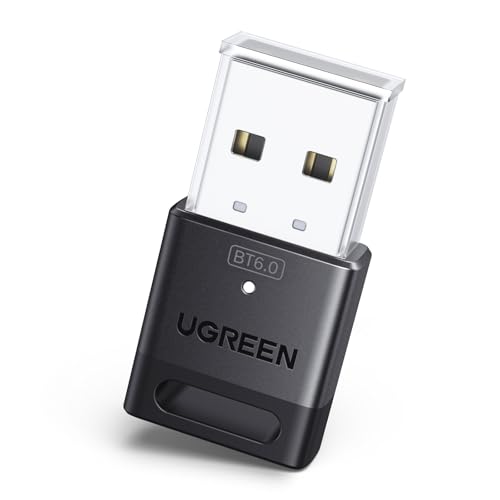
- Connects up to five types of Bluetooth devices
- Bluetooth 6.0 includes EDR and BLE
- Windows-only; Linux and macOS are unsupported
Best For: Windows PCs with multiple Bluetooth peripherals
Linux Classic – Panda Bluetooth 4.0 Nano Adapter
The Panda Bluetooth 4.0 USB Nano Adapter is a straightforward choice for shoppers seeking bluetooth adapters for linux. It supports Linux distributions including Mint, Ubuntu, Fedora, openSUSE, Lubuntu, Zorin, Kali Linux, Raspbian Wheezy, and OpenELEC, along with older Windows systems.
Best For: Linux users who need a compact adapter for keyboards, smartphones, and other Bluetooth electronics.
Pros:
- Supports Bluetooth 4.0 LE and EDR.
- Broad listed Linux distribution compatibility.
- Nano-sized USB design with an advertised range of up to 80 feet when connected to a Bluetooth Smart device.
Cons:
- Uses the older Bluetooth 4.0 standard.
- The supplied notes do not list a specific Linux setup process.
This adapter is a sensible budget-oriented option when broad Linux support matters more than the newer features of current Bluetooth generations.
Windows Only – TP-Link UB500 Bluetooth 5.4 Adapter
The TP-Link UB500 offers Bluetooth 5.4, EDR, and BLE in a very small USB form factor. However, despite its strong wireless feature set, it is not one of the bluetooth adapters for linux: the supplied notes explicitly state that it supports Windows only and does not support Linux.
Best For: Windows 8.1, 10, or 11 PCs that need a compact adapter for peripherals, phones, printers, or headsets.
Pros:
- Bluetooth 5.4 with backward compatibility through Bluetooth 1.1.
- Nano design can remain inserted in a USB port.
- Supports EDR and Bluetooth Low Energy for faster, lower-power connections.
Cons:
- Does not support Linux or macOS.
- Windows 7 requires a downloadable driver.
- Existing internal Bluetooth should be disabled to help avoid driver conflicts.
Choose this model only for a compatible Windows computer. Linux shoppers should skip it and select an adapter with explicit Linux support instead.
Linux Ready – Cudy BU530 Bluetooth 5.3 Adapter
The Cudy BU530 is a strong fit for shoppers comparing bluetooth adapters for linux because its supplied specifications explicitly list Linux compatibility. It adds Bluetooth 5.3 through USB-A and supports manual Linux driver installation from Cudy’s download center.
Best For: Linux and Windows users upgrading a desktop or laptop with Bluetooth 5.3 connectivity.
Pros:
- Explicitly compatible with Linux and Windows 7, 8.1, 10, and 11.
- Bluetooth 5.3 supports reduced audio lag and faster pairing than older versions.
- Compact 20 x 15 x 8 mm nano design weighs about 2 grams.
Cons:
- Linux users may need to download and manually install the driver.
- Requires a USB-A port.
With current Bluetooth support and clear Linux compatibility, the BU530 is one of the most practical choices here for mixed-device households and Linux desktops.
Extended Reach – TP-Link UB500 Plus Long-Range Adapter
The TP-Link UB500 Plus combines Bluetooth 5.3 and EDR with an adjustable antenna designed to improve reception. It may look appealing among bluetooth adapters for linux, but the supplied notes list Windows compatibility only, so Linux buyers should verify support before purchasing.
Best For: Windows desktops or laptops that need potentially broader coverage than a nano adapter provides.
Pros:
- Bluetooth 5.3 with backward compatibility through Bluetooth 1.1.
- Adjustable, multi-direction antenna for positioning the receiver.
- Advertised up to twice the speed and four times the coverage of Bluetooth 4.0, with EDR and BLE support.
Cons:
- The supplied compatibility information lists Windows only, not Linux.
- Larger than a nano adapter.
- Windows 7 requires a driver download.
The adjustable antenna makes this a reasonable Windows-focused option where placement and reception are priorities. For Linux, choose a model with explicit support instead.
Best Compact Pick – ASUS USB-BT600 Bluetooth 6.0 Adapter
If you want compact bluetooth adapters for linux, the ASUS USB-BT600 is a straightforward option for a desktop or laptop. It supports Bluetooth 6.0, Bluetooth Low Energy, and up to seven connected devices, while remaining small enough for easy portability.
Best For: Linux users who want a compact adapter with support for multiple Bluetooth devices.
Pros:
- Supports Bluetooth 6.0 and Bluetooth Low Energy.
- Can connect up to seven devices.
- Ultra-compact USB design.
- Compatible with Linux and Windows 10/11.
Cons:
- Uses a USB 2.0 Type-A interface.
- No extended-range antenna is listed.
The USB-BT600 is a practical fit when size and multi-device support matter more than specialized long-range hardware. Its Linux compatibility and three-year warranty add useful reassurance for everyday upgrades.
Best Long-Range Pick – StarTech Bluetooth 5.3 USB Adapter
For shoppers comparing bluetooth adapters for linux, the StarTech Bluetooth 5.3 USB Adapter stands out for its Class 1 design and stated open-area range of up to 328 feet. It also supports audio streaming, PAN networking, BLE, and Linux Kernel 5.19.0 or newer.
Best For: Linux desktops and laptops that need extended range for audio, peripherals, or networking.
Pros:
- Class 1 Bluetooth 5.3 with an omni-directional antenna.
- Stated range of up to 328 feet in open environments.
- Supports A2DP audio and Bluetooth PAN.
- Native Linux support for Kernel 5.19.0 and newer.
Cons:
- Linux support requires Kernel 5.19.0 or newer.
- The adapter is larger than ultra-compact alternatives.
This StarTech model is the more feature-focused choice for Linux systems with newer kernels. Its antenna and Class 1 radio make it especially appealing where connection distance and stability are priorities.
Best Range on Windows – Techkey Long Range Bluetooth 5.4 Adapter
Although it is not suitable for Linux, this Techkey dongle is worth distinguishing in a roundup of bluetooth adapters for linux because its operating-system limitation is important. It offers Bluetooth 5.4, Class 1 connectivity, an extended antenna, and a claimed open-area range of up to 500 feet, but supports Windows 11, 10, and 8.1 only.
Best For: Windows users who need long-range Bluetooth connectivity and do not require Linux support.
Pros:
- Bluetooth 5.4 with dual-mode BR/EDR and BLE.
- Class 1 radio and extended antenna support up to 500 feet in open areas.
- Supports connections to up to five devices.
- Advertised plug-and-play operation.
Cons:
- Not compatible with Linux, macOS, TVs, game consoles, or car stereo systems.
- Actual range can be reduced by obstructions and interference.
- Not an appropriate choice for a Linux computer.
The Techkey adapter has compelling range specifications, but the explicit lack of Linux support makes it a poor match for this keyword. Consider it only for a Windows system where extended range is the primary requirement.
Best Windows WiFi Combo – BrosTrend AX900 WiFi 6 + Bluetooth 5.4
If you need bluetooth adapters for linux, note that this BrosTrend combo is not a Linux option: it supports Windows 10 and 11 only. For compatible Windows PCs, it adds WiFi 6 and Bluetooth 5.4 through one USB adapter, making it useful when you want to upgrade both connections at once.
Best For: Windows desktop, laptop, or mini-PC users who want WiFi and Bluetooth in a single adapter.
Pros:
- Combines WiFi 6 AX900 and Bluetooth 5.4 in one USB device.
- Supports up to four connected Bluetooth devices, including headphones, keyboards, mice, speakers, printers, and controllers.
- Uses a 6 dBi external antenna and Beamforming to improve WiFi reception.
- Includes pre-loaded Windows 10/11 drivers and a two-year manufacturer warranty.
Cons:
- Does not support Linux or macOS.
- Bluetooth and 2.4 GHz WiFi can experience interference because they share the same band.
- Bluetooth is intended for Windows PCs, not direct use with PlayStation or Xbox consoles.
This is a practical all-in-one upgrade for Windows users, especially in areas with weaker WiFi reception. Linux buyers should choose a model with explicit Linux support instead.
Best Multi-Device Dongle – UGREEN Bluetooth 6.0 USB Adapter
Although it may appear in searches for bluetooth adapters for linux, this UGREEN dongle does not support Linux. It is a Windows-only Bluetooth 6.0 adapter designed for PCs that need wireless connections for peripherals such as headphones, keyboards, mice, speakers, and printers.
Best For: Windows 8.1, 10, and 11 PC users who need to connect several Bluetooth peripherals through one compact dongle.
Pros:
- Uses Bluetooth 6.0 with EDR and BLE technology.
- Can connect up to five different types of Bluetooth devices at the same time.
- Plug-and-play installation is supported on Windows 8.1, 10, and 11.
- Backwards compatible with Bluetooth 5.4 and 5.3 devices.
Cons:
- Linux, macOS, and Windows 7 are not supported.
- Only one Bluetooth audio device of the same type can play music at a time.
- Not designed for direct use with game consoles, televisions, or cars.
This is a straightforward Windows Bluetooth upgrade with useful multi-device capacity. It should be removed from consideration if Linux compatibility is a requirement.
Best Compact Combo – TP-Link Archer TX10UB Nano
For shoppers comparing bluetooth adapters for linux, the TP-Link Archer TX10UB Nano is another important compatibility check: its supplied specifications list Windows 10 and 11 support, not Linux. On supported PCs, it combines WiFi 6 AX900 with Bluetooth 5.3 in a tiny USB design that can stay plugged in.
Best For: Windows desktop and laptop users who want a discreet WiFi-and-Bluetooth upgrade for peripherals and everyday networking.
Pros:
- Combines dual-band WiFi 6 with Bluetooth 5.3 in a travel-size adapter.
- Offers up to 600 Mbps on 5 GHz and 287 Mbps on 2.4 GHz.
- Supports OFDMA, MU-MIMO, WPA3, and connections for peripherals such as headphones, keyboards, mice, and controllers.
- Nearly invisible nano design and pre-loaded drivers simplify installation on Windows 10/11.
Cons:
- Linux and macOS compatibility is not listed; supplied support is for Windows 10/11.
- Existing internal Bluetooth, and possibly internal WiFi, may need to be disabled to avoid conflicts.
- Bluetooth is intended for PC use and cannot be used directly on consoles.
The TX10UB Nano is a tidy choice for a supported Windows system, particularly when space and portability matter. Linux users should verify driver support elsewhere before buying.
How We Picked These Bluetooth Adapters for Linux
We focused on adapters that offer a useful combination of Linux compatibility, current Bluetooth support, compact or practical designs, and clear positioning for different desktop setups. The selection includes basic Bluetooth 4.0 models, newer Bluetooth 5.x and 6.0 dongles, Class 1 long-range options, and dual-purpose Wi-Fi/Bluetooth adapters.
Because Linux support can depend on the kernel, distribution, firmware, and desktop environment, compatibility claims should be treated as a starting point rather than a guarantee. Before buying, check the manufacturer’s specifications and your distribution’s hardware reports when possible.
Quick Comparison
| Type | Best For | What to Expect |
|---|---|---|
| Compact Bluetooth 4.0 dongle | Basic keyboards, mice, and controllers | Low cost and broad compatibility, but older performance |
| Bluetooth 5.3–5.4 adapter | Modern peripherals and general desktop use | Newer features, improved efficiency, and stronger future value |
| Bluetooth 6.0 adapter | Long-term upgrades | Latest-generation specification; verify Linux feature support |
| Class 1 or long-range adapter | Large rooms and distant devices | Greater potential range with suitable antennas and devices |
| Wi-Fi/Bluetooth combo adapter | Desktops needing both radios | One USB device, but possible driver and interference considerations |
Key Buying Factors for Bluetooth Adapters for Linux
Linux and Kernel Compatibility
Look for explicit Linux support, but also identify the chipset when available. Native kernel support is generally preferable to relying on unofficial drivers. Ubuntu, Fedora, Debian-based distributions, and specialized distros may recognize the same adapter differently depending on kernel and firmware versions.
Bluetooth Generation and Profiles
Bluetooth 5.3, 5.4, and 6.0 can offer efficiency and newer capabilities, but the connected device must support those features too. Confirm support for the profiles you need, such as A2DP for audio, HID for keyboards and mice, and game-controller compatibility.
Range, Antenna, and USB Placement
Compact nano adapters are convenient but may have limited range behind a metal desktop case. For distant headphones, controllers, or speakers, consider a Class 1 or long-range model, and use a short USB extension cable to move the dongle away from interference.
USB Ports and Interference
Check whether the adapter uses USB-A or another connector and avoid placing it directly beside busy USB 3.x devices when possible. Wi-Fi and Bluetooth combo adapters can be convenient, but they may require more careful driver setup and radio coexistence management.
Who Should Buy Which Bluetooth Adapters for Linux?
Choose a simple nano adapter if you mainly need a wireless keyboard, mouse, or occasional controller connection on a compact desktop. Pick a newer Bluetooth 5.3 or 5.4 model for a balanced everyday upgrade. A Bluetooth 6.0 dongle makes more sense for buyers prioritizing specification longevity, provided their Linux setup recognizes it properly.
For devices used across a room, select a Class 1 or explicitly long-range adapter and keep expectations realistic: walls, interference, and the receiving device still limit performance. If your desktop also lacks modern Wi-Fi, a 2-in-1 Wi-Fi/Bluetooth adapter can save a USB port, but separate adapters may be easier to troubleshoot on Linux.