
The best handheld voice recorders make it easier to capture lectures, meetings, interviews, and personal notes without relying on a phone. This roundup compares traditional digital recorders with newer AI-powered options that can transcribe and summarize audio.
We focused on recording quality, storage, battery life, controls, portability, playback, and workflow features so you can choose a device that fits the way you actually record.
Best 10 Handheld Voice Recorders Picks for 2026
Best for Long Recording Sessions
EVISTR L357 Digital Voice Recorder

- 64GB storage with voice activation
- Up to 32 hours of continuous recording
- USB-C transfer and playback tools
Best For: Students and professionals needing extensive local storage
Best for AI Transcription

- Transcription in 112 languages
- Phone-call and in-person recording modes
- 64GB local storage with app summaries
Best For: Professionals turning conversations into organized notes
Best for Maximum Storage
EVIDA 128GB Digital Voice Recorder

- 128GB capacity for up to 9,296 hours
- 1536Kbps PCM recording option
- Password protection and four-folder storage
Best For: Users seeking extensive local storage and organized files
Best Wearable Recorder
Plaud NotePin S Wearable AI Recorder

- Pin, clip, lanyard, and wristband included
- AI transcription in 112 languages
- 64GB storage with 20-hour recording time
Best For: Hands-free meeting and conversation recording
Best Value for Everyday Recording
HoTiyan 8GB Digital Voice Recorder

- Stereo recording with noise reduction
- Voice activation and rechargeable battery
- A-B repeat and variable playback speed
Best For: Students and everyday users needing simple recording and playback
Best for AI-Powered Notes
EVISTR 128GB AI Voice Recorder

- Transcription in 113 languages with smart summaries
- 128GB storage and up to 33 hours of recording
- OTG phone transfer with privacy lock
Best For: Students and professionals creating organized notes from recordings
Best Simple Sony Option

- Quick MP3 recording
- Built-in USB for direct PC transfer
- Up to 57 hours of battery life
Best For: Users wanting uncomplicated recording and computer transfers
Best AI-Powered Pick
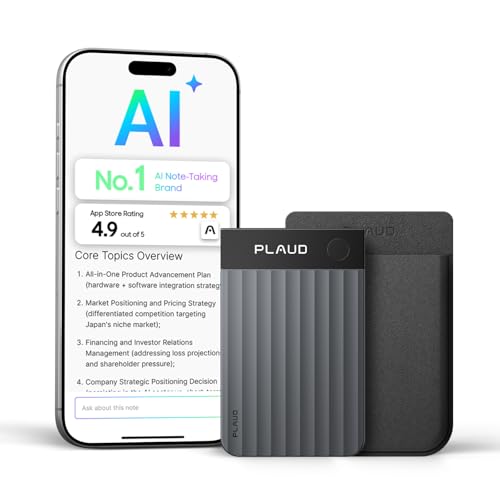
- AI transcription and summaries in 112 languages
- Dual-mode recording for calls and in-person conversations
- Slim 64GB recorder with 30-hour recording time
Best For: Professionals who need recordings converted into organized meeting notes
Best Simple Budget Recorder

- One-button recording and built-in playback speaker
- Up to 30 hours of continuous recording
- Voice activation, noise reduction, and USB file transfer
Best For: Students and casual users who want simple lecture and meeting recording
Best Long-Battery Option

- Up to 72 hours of digital recording time
- 64GB storage with MP3 and WAV support
- 2-inch OLED display with voice activation
Best For: Users recording long lectures, meetings, interviews, or personal memos
Best for Long Recording Sessions – EVISTR L357 Digital Voice Recorder
For shoppers comparing handheld voice recorders, the EVISTR L357 emphasizes storage, straightforward controls, and flexible recording options. Its 64GB capacity, voice activation, adjustable gain, and playback tools make it suitable for capturing lectures, meetings, interviews, and personal notes.
Best For: Students, teachers, writers, and professionals who want substantial storage and simple physical recording controls.
Pros:
- 64GB storage can hold up to 4,660 hours at 32Kbps.
- PCM noise reduction, adjustable seven-level gain, and up to 1536Kbps stereo recording support clearer captures.
- Voice activation, scheduled recording, variable-speed playback, and A-B repeat add useful flexibility.
- USB-C connectivity and Windows/Mac compatibility simplify file transfers.
Cons:
- It does not offer built-in AI transcription or summarization.
- Its feature-rich menu may require learning beyond the basic record and save buttons.
The L357 is a practical traditional recorder rather than a connected note-taking system. Choose it when local storage, long battery performance, and direct file access matter more than automated transcription.
Best for AI Transcription – Plaud Note AI Voice Recorder
The Plaud Note takes a different approach to handheld voice recorders by pairing local audio capture with app-based transcription and summaries. It supports phone-call and in-person recording modes, stores audio locally, and can turn conversations into structured notes through the Plaud app and web platform.
Best For: Professionals who want recordings converted into transcripts, summaries, mind maps, or task lists.
Pros:
- Transcribes conversations in 112 languages and offers more than 10,000 professional templates.
- Its 0.12-inch-thin, 1.06-ounce design is easy to carry.
- Dual-mode recording supports phone calls and in-person meetings.
- 64GB local storage, encrypted data, and stated privacy compliance support sensitive workflows.
Cons:
- Transcription features are tied to the Plaud app and its monthly Starter Plan allowance or paid upgrades.
- There is no headphone jack.
- It is less suited to buyers who want a completely standalone recorder without app services.
Plaud Note is compelling when reducing manual note-taking is the priority. Its subscription options and app dependence should be considered alongside the convenience of automated transcription and summaries.
Best for Maximum Storage – EVIDA 128GB Digital Voice Recorder
Among handheld voice recorders, the EVIDA 128GB model stands out for high capacity and traditional recorder features. It combines PCM recording, voice activation, password protection, folder organization, and playback in a compact device designed for lectures, meetings, speeches, and interviews.
Best For: Users who prioritize maximum onboard storage, long recording time, and password-protected local files.
Pros:
- 128GB storage is rated for up to 9,296 hours of recording.
- Supports MP3 recording at multiple bit rates and WAV recording at 1536Kbps.
- Voice activation, four-folder file management, bookmarks, A-B repeat, and auto-record improve organization.
- Can also function as a USB flash drive and MP3 player.
Cons:
- The supplied specifications list no headphone jack.
- It does not provide AI transcription or cloud-based summaries.
- Its many functions may be more than needed for basic recording.
The EVIDA is a strong fit for buyers who want a high-capacity, self-contained recorder with practical file controls. It favors local recording and organization over smartphone-connected features.
Best Wearable Recorder – Plaud NotePin S Wearable AI Recorder
The Plaud NotePin S is a wearable alternative to conventional handheld voice recorders. Its included pin, clip, lanyard, and wristband let you keep it accessible during conversations, while the Plaud app handles transcription, summaries, and cross-device management.
Best For: Professionals who want hands-free recording with AI-assisted organization of meetings and conversations.
Pros:
- Multiple wearing options include a pin, clip, lanyard, and wristband.
- Transcribes in 112 languages and supports more than 10,000 professional templates.
- Its physical record button provides direct recording control.
- 64GB local storage, 20 hours of continuous recording, and 40 days of standby time support regular use.
Cons:
- AI transcription and summaries require use of the Plaud app and may involve plan limits or upgrades.
- It has no headphone jack.
- Its 20-hour continuous recording time is shorter than some traditional recorders in this roundup.
NotePin S is best when discreet portability and wearable convenience matter more than maximum standalone battery life. The included accessories make it adaptable, while the Plaud platform adds value for users who regularly turn recordings into follow-up work.
Best Value for Everyday Recording – HoTiyan 8GB Digital Voice Recorder
If you want a straightforward option among handheld voice recorders, this HoTiyan model combines stereo recording, voice activation, and simple three-button controls. Its 8GB storage, rechargeable battery, and MP3 playback make it practical for lectures, meetings, interviews, and study sessions.
Best For: Students and everyday users who want a compact recorder with voice activation, replay tools, and built-in MP3 playback.
Pros:
- Higher-sensitivity stereo microphone with noise reduction and MP3/WAV recording.
- Voice-activated recording can reduce silent sections and conserve storage.
- Rechargeable battery supports up to 20 hours of continuous recording.
- A-B repeat, variable playback speed, password protection, and timestamped files add useful convenience.
Cons:
- Storage is limited to 8GB compared with higher-capacity alternatives.
- File transfers use the supplied Micro USB cable rather than a newer USB-C connection.
This is a feature-rich budget choice for routine recording and review. Its simple controls and study-oriented playback features are particularly useful when you need to revisit key sections without managing a complicated interface.
Best for AI-Powered Notes – EVISTR 128GB AI Voice Recorder
For shoppers seeking handheld voice recorders that do more than save audio, the EVISTR L359 adds AI transcription and summaries through its AI DVR Link app. It pairs high-capacity storage with noise reduction, voice activation, one-touch recording, and wired OTG transfers to compatible phones.
Best For: Students and professionals who want to record lectures, meetings, or interviews and turn them into searchable notes and summaries.
Pros:
- AI features include transcription in 113 languages, summaries, mind maps, speaker identification, and Ask AI insights.
- Records up to 3072Kbps HD audio with intelligent noise reduction and voice-activated recording.
- 128GB storage holds up to 9,216 hours at 32kbps, while battery life reaches up to 33 hours of continuous recording.
- One-touch recording, password encryption, a HOLD switch, and wired OTG transfer improve usability and privacy.
Cons:
- AI transcription and related features require the AI DVR Link app and a compatible phone connection.
- The built-in microphone operates in mono and speech-recognition modes rather than stereo.
The L359 is the most advanced choice in this group for turning recordings into organized information. Its large storage and app-based workflow suit heavy users, though buyers should be comfortable using wired OTG transfers and the companion app.
Best Simple Sony Option – Sony ICD-PX370 Mono Recorder
Sony ICD-PX370 Mono Digital Voice Recorder with Built-In USB Voice Recorder,black
Check Price On AmazonThe Sony ICD-PX370 is a no-frills choice among handheld voice recorders, emphasizing quick MP3 recording and easy computer transfers. Its built-in USB connection and replaceable AAA batteries make it suitable for users who prefer a familiar, uncomplicated recorder.
Best For: Buyers who want a dependable basic recorder for straightforward voice capture and direct PC file transfers.
Pros:
- Records MP3 audio quickly and easily.
- Built-in USB connection enables direct file transfer to a PC.
- Offers up to 57 hours of battery life for extended recording.
- Uses two AAA batteries, which are replaceable rather than dependent on a built-in rechargeable pack.
Cons:
- Its 4GB storage is smaller than the capacity offered by the other listed recorders.
- The recorder is designed for mono recording, which may be less suitable for users seeking stereo audio.
- It uses a 2.5mm headphone jack rather than the more common 3.5mm jack.
This Sony is a practical pick when simplicity matters more than advanced features. It lacks voice activation, AI tools, and larger storage, but its direct USB design and long stated battery life make routine recording and PC transfer easy.
Best AI-Powered Pick – Plaud Note Pro
For shoppers seeking handheld voice recorders that do more than capture audio, the Plaud Note Pro combines recording with automatic transcription and meeting summaries. Its dual-mode recording supports phone calls and in-person conversations, while Plaud Intelligence adds speaker labels, action items, decisions, and follow-ups.
Best For: Professionals who want compact recording plus AI-generated notes for meetings, calls, and interviews.
Pros:
- Transcribes in 112 languages and provides speaker labels.
- Automatically creates structured summaries, action items, and follow-ups.
- 64GB storage, a 30-hour recording time, and a slim 1.06-ounce design.
- Works across Plaud Desktop, Web, and mobile, with a free plan including 300 AI transcription minutes per month.
Cons:
- Its most advanced transcription access depends on Plaud plan limits or upgrades.
- No headphone jack.
- AI features may be more than needed for simple voice recording.
The Note Pro is a strong choice when the goal is turning conversations into usable notes rather than simply storing audio. Its small credit-card-style body and included magnetic accessories make it convenient to carry, but buyers should consider the ongoing AI-plan structure.
Best Simple Budget Recorder – Sunlan 16GB Voice Recorder
The Sunlan is one of the more straightforward handheld voice recorders for lectures, meetings, interviews, and personal notes. Its one-button recording controls, built-in playback speaker, and USB file transfer keep the experience focused on capturing and reviewing audio without an app or subscription.
Best For: Students and everyday users who want an easy-to-operate recorder with direct playback and USB storage.
Pros:
- Simple REC, STOP, and PLAY controls are easy to learn.
- 16GB storage and up to 30 hours of continuous recording.
- Voice activation can begin recording when sound is detected.
- Includes noise reduction, a 3.5mm headphone jack, and removable-drive USB use.
Cons:
- Mono recording and built-in microphone operation are less flexible than more advanced setups.
- Playback battery life is listed at 7 hours, shorter than its recording time.
- Storage is more limited than 64GB alternatives.
This Sunlan model makes sense for buyers who value uncomplicated controls and dependable local recording. It also doubles as a music player and removable data-storage device, making it versatile, though its basic mono design is best suited to personal use rather than demanding production work.
Best Long-Battery Option – Jaswill 64GB Voice Recorder
The Jaswill stands out among handheld voice recorders for its large storage capacity, long stated battery life, and larger 2-inch display. It supports MP3 and WAV recording, includes voice activation and noise cancellation, and is designed for extended meetings, lectures, interviews, podcasts, and personal memos.
Best For: Users who need extended recording sessions, generous storage, and a readable on-device display.
Pros:
- 64GB of storage accommodates long recording sessions.
- Up to 72 hours of digital recording time and an 80-hour stated battery life.
- Supports both MP3 and WAV audio formats.
- 2-inch OLED display shows recording status, battery level, and other operating information.
Cons:
- At 100 grams and nearly 5 inches long, it is less compact than smaller recorders.
- Built-in mono microphone operation is intended for basic recording rather than multi-microphone capture.
- Advanced security is described as 6-bit digital encryption, which may be limited for highly sensitive files.
Choose the Jaswill when recording endurance matters more than pocket-size portability. Its storage, display, voice activation, and format support make it practical for frequent or lengthy sessions, while the larger body may be a trade-off for users seeking an ultra-compact device.
How We Picked These Handheld Voice Recorders
We selected models that cover the main ways people use Handheld Voice Recorders, from straightforward lecture and interview recording to AI-assisted transcription and meeting summaries. The comparison considers storage capacity, microphone performance, recording formats, battery expectations, playback controls, portability, and how easily files can be transferred.
Because needs vary widely, the list includes both conventional digital dictaphones and connected AI recorders. Traditional models are generally simpler and may avoid subscription-dependent services, while AI devices can save time when searchable transcripts and summaries matter more than basic recording.
Quick Comparison
| Best For | Look For | Typical Strength |
|---|---|---|
| Lectures and classes | Long battery life, voice activation, ample storage | Hands-free recording and easy review |
| Meetings and interviews | Clear microphones, simple controls, reliable file transfer | Consistent capture and playback |
| Transcription workflows | AI transcription, summaries, app support | Faster conversion from audio to notes |
| Private notes | Compact design, quick start, password protection | Convenient everyday use |
| Music and general audio | Playback controls, headphone support, useful storage | Flexible listening and file management |
Key Buying Factors for Handheld Voice Recorders
Recording Quality and Microphones
Look for a microphone arrangement suited to your environment. A recorder used close to a speaker may not need the same pickup range as one placed at the center of a conference table. Noise reduction can help, but it cannot fully replace good placement and a quiet recording position.
Storage and File Management
More storage is useful for long lectures, frequent interviews, and recordings made before you have time to transfer them. Check the advertised recording capacity against the chosen audio quality, since higher-quality files consume space faster. Built-in USB or straightforward computer connectivity also makes archiving easier.
Battery Life and Controls
Choose a recorder with enough battery capacity for your longest sessions, plus a margin for unexpected delays. Physical buttons are often preferable when you need to start, stop, pause, or mark a recording quickly. Voice activation can reduce silent sections but should be tested before important use.
AI Transcription, Privacy, and Cost
AI models can turn recordings into searchable text and summaries, but verify whether processing requires an app, an account, an internet connection, or a paid plan. If sensitive conversations are involved, review how audio and transcripts are stored and processed before committing.
Who Should Buy Which Handheld Voice Recorders?
Students and lecture attendees should prioritize long battery life, generous storage, voice activation, and simple playback. Interviewers and meeting users should favor clear microphones, dependable file transfer, and controls that can be operated without looking away from the conversation.
Choose an AI recorder if reducing transcription time is your main goal and you are comfortable with its software ecosystem. A wearable AI model may suit people who want discreet, hands-free capture, while a conventional recorder is usually the better fit for buyers seeking a simpler device with fewer ongoing requirements. For occasional notes, prioritize compact size, fast startup, and easy charging over maximum storage or advanced features.