
The best voice recorders make it easier to capture lectures, meetings, interviews, calls, and personal notes without relying on a phone. Today’s options range from simple playback devices to AI-powered recorders that transcribe and summarize conversations.
We compared storage, recording quality, battery performance, ease of use, noise reduction, playback features, and transcription tools to help you choose the right recorder for your needs.
Best 10 Voice Recorders Picks for 2026
Best High-Capacity Classic

- 64GB storage and up to 32 hours of recording
- PCM noise reduction with adjustable gain
- Simple controls, playback, and voice activation
Best For: Students and professionals wanting a traditional recorder
Best AI Meeting Companion
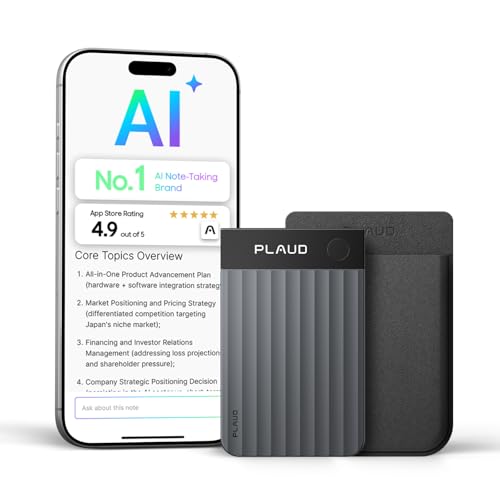
- Transcribes in 112 languages with speaker labels
- Creates summaries, action items, and follow-ups
- Slim design with phone-call and in-person modes
Best For: Professionals managing meetings and calls
Best for Extended Recording

- Up to 68 hours of continuous recording
- 136GB total storage with included TF card
- Noise reduction, voice activation, and one-click recording
Best For: Long lectures, interviews, and recurring meetings
Best Hybrid AI Recorder

- AI transcription and summaries in 113 languages
- 3072Kbps recording with noise reduction
- 128GB storage and wired OTG phone transfer
Best For: Users wanting recording plus optional app-based AI notes
Best Value Stereo Recorder

- Stereo recording with noise reduction
- Voice activation reduces silent sections
- A-B repeat and variable playback speed
Best For: Students and everyday lecture or meeting recording
Simple One-Button Pick

- One-button recording and playback
- DSP noise reduction for speech
- 16GB storage with voice activation
Best For: Users wanting simple lecture, interview, or meeting recording
Longest-Running Option

- 5000mAh battery rated for extended recording
- 128GB storage for large file libraries
- AI noise reduction and magnetic attachment
Best For: Long meetings, interviews, and extended hands-free recording
Best Smart Transcription Recorder

- Three specialized stereo microphones
- Sembly AI speech-to-text trial
- 8GB storage and long recording capacity
Best For: Meetings, lectures, interviews, and faster documentation
Best High-Capacity Recorder
EVIDA 128GB Digital Voice Recorder

- 128GB storage capacity
- 1536kbps PCM recording
- Voice activation and password protection
Best For: Lectures, meetings, interviews, and organized file storage
Best Easy-Use Stereo Recorder
Arungo 128GB Digital Voice Recorder

- 1536kbps stereo PCM recording
- 128GB TF card included
- One-button and voice-activated recording
Best For: Lectures, meetings, interviews, and everyday dictation
Best High-Capacity Classic – EVISTR 64GB Voice Recorder
If you want straightforward voice recorders for lectures, meetings, or interviews, this EVISTR model emphasizes easy operation, ample storage, and playback controls. Its PCM noise reduction, adjustable gain, and voice activation give you flexibility when recording in different environments.
Best For: Students, teachers, writers, and professionals who want a traditional recorder with long battery life and simple controls.
Pros:
- 64GB storage can hold up to 4,660 hours at 32Kbps.
- Records in WAV or MP3 and supports up to 1536Kbps stereo audio.
- Offers seven recording-gain levels and seven voice-activation sensitivity levels.
- Provides up to 32 hours of continuous recording and includes USB-C file transfer.
Cons:
- Its AI transcription and summarization features are not listed.
- The compact one-inch screen may provide less viewing space than larger-screen recorders.
This is a practical choice when reliable recording, generous built-in storage, and direct file management matter more than connected productivity features.
Best AI Meeting Companion – Plaud Note Pro AI Recorder
Among voice recorders, the Plaud Note Pro stands out for turning recordings into organized notes rather than simply storing audio. Its dual-mode recording, AI transcription, speaker labels, summaries, and cross-device workspace make it especially suited to meeting-heavy workflows.
Best For: Professionals and teams who need searchable transcripts, meeting summaries, action items, and follow-ups.
Pros:
- Transcribes in 112 languages with speaker labels and structured summaries.
- Automatically switches between phone-call and in-person recording modes.
- Works across Plaud Desktop, Web, and mobile apps, with a free plan including 300 transcription minutes per month.
- Ultra-slim 0.12-inch design weighs 1.06 ounces and includes a magnetic case and ring.
Cons:
- AI transcription and summaries depend on the Plaud app and its plan limits.
- It has no headphone jack and lists 30 hours of recording time.
- Users must notify others and follow applicable recording laws.
The Note Pro is less about basic dictation and more about an end-to-end note-taking system. It is the strongest fit here for buyers willing to use an app-based AI workflow.
Best for Extended Recording – Tonfarb 136GB Voice Recorder
This Tonfarb model is one of the most practical voice recorders for long sessions, combining 136GB of total storage with a 1100mAh battery. One-click recording, voice activation, noise reduction, and an easy-to-read LCD screen make it suitable for lectures, interviews, and back-to-back meetings.
Best For: Users who prioritize substantial storage and extended battery life for frequent or lengthy recordings.
Pros:
- Includes 8GB built-in storage and a 128GB TF card for up to 9,775 hours in MP3 format.
- Provides up to 68 hours of continuous recording on one charge.
- Supports 1536Kbps PCM audio, automatic noise reduction, and voice-activated recording.
- Offers one-click recording, A-B repeat, password protection, and USB-C transfer.
Cons:
- At about 100 grams, it is heavier than some compact recorders.
- The included TF card and high capacity may be more storage than occasional users need.
Choose the Tonfarb when recording endurance is the deciding factor. It delivers a strong combination of capacity, battery runtime, and conventional playback features without requiring an AI service.
Best Hybrid AI Recorder – EVISTR L359 128GB AI Recorder
The EVISTR L359 combines the familiar controls of portable voice recorders with app-based AI transcription and summaries. It records up to 3072Kbps, supports voice activation, and connects to a phone through wired OTG for transferring audio into the AI DVR Link app.
Best For: Students and professionals who want local recording, large storage, and optional transcription or summarization through a phone app.
Pros:
- AI DVR Link supports transcription in 113 languages, summaries, mind maps, speaker identification, and Ask AI insights.
- Offers up to 3072Kbps recording with intelligent noise reduction and voice activation.
- 128GB storage holds up to 9,216 hours at 32Kbps.
- Includes password encryption, a HOLD switch, USB-C, and wired OTG phone transfer.
Cons:
- Continuous recording time is listed at up to 33 hours.
- AI processing requires the AI DVR Link app and a compatible phone connection.
- Its wired OTG workflow is less convenient for buyers seeking Bluetooth connectivity.
The L359 is a versatile middle ground: it works as a conventional recorder while adding AI tools when needed. Its wired transfer approach may appeal to users who prefer a direct connection over Bluetooth.
Best Value Stereo Recorder – 8GB Voice Recorder
If you want practical voice recorders for lectures, meetings, or interviews, this 8GB model combines stereo recording, voice activation, and simple three-button controls. It also supports MP3 playback and includes useful tools such as A-B repeat, variable playback speed, and password protection.
Best For: Students and everyday users who want a compact recorder with stereo audio, voice activation, and playback features.
Pros:
- Higher-sensitivity microphone, noise reduction, and a professional recording chip support high-definition stereo recording.
- Voice activation can reduce silent sections and conserve storage space.
- Built-in 8GB storage supports multiple recording-quality settings, with up to 20 hours of continuous recording per charge.
- Supports MP3 and WAV files, USB file transfer, A-B repeat, variable playback speed, and password protection.
Cons:
- Its 8GB capacity is smaller than the storage offered by some larger recorders.
- The supplied details specify a Micro USB connection rather than USB-C.
This is a flexible choice for routine note-taking and review. Its stereo microphone and learning-focused playback tools make it especially useful when you need to revisit selected portions of a recording.
Simple One-Button Pick – 16GB Voice Recorder
Among voice recorders designed for straightforward use, this 16GB model keeps the controls simple: press REC to begin, STOP to finish, and PLAY to review. It adds noise reduction, voice activation, A-B repeat, and USB storage functionality for lectures, interviews, and meetings.
Best For: Users who prioritize easy operation, clear voice capture, and more built-in storage than a basic 8GB recorder.
Pros:
- One-button recording and an internal speaker make recording and playback easy to manage.
- DSP noise reduction and a sensitive microphone are designed to capture clearer speech.
- Voice activation can begin recording when sound is detected and enter standby during quieter periods.
- 16GB storage, USB file transfer, music-player functionality, and removable-drive use add versatility.
Cons:
- Its stated continuous recording time is more than 30 hours, with about 7 hours of playback.
- The recording format listed in the supplied details is WAV only.
- The microphone operation is mono rather than stereo.
This recorder is a sensible fit when uncomplicated controls matter most. The larger 16GB capacity and voice-activated mode support regular use, while the mono recording design keeps it focused on speech capture.
Longest-Running Option – 128GB AI Voice Recorder
For buyers comparing voice recorders for extended sessions, this 128GB model emphasizes endurance and storage. It combines AI-assisted triple noise reduction, voice activation, a 5000mAh battery, USB-C transfer, and dual magnets for hands-free placement on ferrous surfaces.
Best For: Users who need very long recording sessions, substantial file storage, or a recorder that can attach magnetically during meetings and interviews.
Pros:
- AI triple noise reduction with DSP processing is designed to improve speech clarity.
- The 5000mAh battery is rated for up to 35 days or 1,000 hours of continuous recording.
- 128GB storage supports up to 9,500 hours of files according to the supplied notes.
- Voice activation, one-touch operation, dual magnetic attachment, and USB-C connectivity add convenience.
Cons:
- Its extensive features may be more than needed for occasional, short recordings.
- The listed recording format is WAV, which may require conversion for some workflows.
- Voice activation starts and stops around the stated 45-decibel threshold, so quiet speech may not trigger recording.
This is the strongest option here for capacity and endurance. Choose it when minimizing charging and file-management interruptions matters more than keeping the device as simple as possible.
Best Smart Transcription Recorder – Philips VoiceTracer DVT4115
Among voice recorders for meetings, lectures, and interviews, the Philips VoiceTracer DVT4115 stands out for its stereo microphone setup and transcription-oriented features. It records in MP3 or PCM, offers remote control through a smartphone app, and includes 8GB of internal storage.
Best For: Business users, students, and anyone who wants recordings converted into searchable text and meeting notes.
Pros:
- Three specialized stereo microphones are designed to capture distant speakers clearly.
- Sembly AI features support speech-to-text and multi-speaker meeting transcription.
- Offers up to 88–89 days of recording time with 8GB of built-in memory.
- Smartphone app remote control makes starting and managing recordings convenient.
Cons:
- The transcription features may be more than casual users need.
- Storage is limited to 8GB compared with 128GB alternatives.
The DVT4115 is a strong choice when documentation matters as much as audio capture. Its stereo recording, long battery life, and transcription tools make it especially practical for recurring meetings and interviews.
Best High-Capacity Recorder – EVIDA 128GB Digital Voice Recorder
For shoppers comparing voice recorders with ample storage, the EVIDA 128GB recorder combines PCM recording, voice activation, playback, and password protection. It can also function as a USB flash drive and MP3 player, making it a versatile option for lectures, meetings, and interviews.
Best For: Students, teachers, business users, and anyone who wants extensive file storage and straightforward playback.
Pros:
- 128GB capacity is listed for storing recordings and music files.
- Supports 1536kbps WAV recording along with MP3 recording options.
- Voice activation can reduce blank sections and conserve storage.
- Includes password protection, bookmarks, A-B repeat, and four-folder file organization.
Cons:
- Mono noise-cancellation microphone operation may provide less spatial detail than stereo models.
- The listed digital recording time is 54 hours despite the large storage capacity.
- No headphone jack is listed in the specifications.
The EVIDA is appealing if capacity and practical file-management tools are priorities. Its voice activation and computer-transfer support are useful for regular recording, while the included phone-based customer assistance may help new users get started.
Best Easy-Use Stereo Recorder – Arungo 128GB Digital Voice Recorder
The Arungo ZD70 is one of the more approachable voice recorders for lectures, meetings, interviews, and dictation. It pairs a one-button recording design with stereo PCM recording, voice activation, 128GB TF-card storage, and time-stamped files for easier organization.
Best For: Users who want simple controls, large storage, voice-activated recording, and immediate playback.
Pros:
- 1536kbps PCM recording and an omnidirectional stereo microphone are designed for clear audio.
- Pre-installed 128GB TF card provides substantial storage for recordings and music.
- Voice activation can start recording when sound is detected and help save storage.
- Includes one-button recording, time-stamped files, playback, speed control, and password lock.
Cons:
- Continuous recording battery life is listed at 50 hours.
- The 1.44-inch screen is relatively compact for navigating files.
- The product uses a nonstandard battery according to the specifications.
The ZD70 offers a useful balance of simplicity and features. Its one-click controls and time-stamped files suit everyday recording, while stereo capture and voice activation add flexibility for longer sessions.
How We Picked the Best Voice Recorders
We focused on the features that matter most in everyday recording: microphone performance, usable storage, battery life, recording formats, playback controls, voice activation, and file transfer. We also considered whether each device suits lectures, meetings, interviews, phone calls, or private note-taking.
AI-enabled models were evaluated separately from traditional digital recorders because transcription and summarization can be valuable, but they may require an app, account, subscription, internet connection, or compatible phone. Storage claims were also treated as maximum capacity rather than a guarantee of a specific recording duration, since recording quality and file format affect available time.
Quick Comparison
| Best For | Look For | Typical Advantage |
|---|---|---|
| Lectures and classes | Voice activation, long battery life, playback | Simple operation and efficient storage |
| Meetings and interviews | Noise reduction, strong microphones, easy file transfer | Clearer speech in busy environments |
| AI notes | Transcription, summaries, app support | Faster conversion of speech into usable notes |
| Discreet everyday recording | Compact design, rechargeable battery, password protection | Portable and convenient note capture |
Key Buying Factors for Voice Recorders
Recording Quality and Noise Control
Choose a recorder with a sensitive microphone and adjustable recording quality if you need intelligible speech at a distance. Noise reduction can help with fans, rooms, and background chatter, but it cannot fully correct poor microphone placement. For interviews or group meetings, microphone direction and placement may matter as much as the advertised specifications.
Storage and File Management
More storage is useful for long lectures and frequent recordings, while expandable storage can offer greater flexibility. Check whether files transfer through USB, whether the recorder works with your computer, and whether recordings can be organized or deleted directly on the device.
Battery Life and Controls
Long battery life is helpful for conferences and full-day classes. Physical buttons, a clear display, and dependable playback are often preferable to complicated menus when you need to start recording quickly. Voice activation can conserve storage and battery by reducing silent sections.
AI Transcription and Privacy
AI recorders can transcribe and summarize speech, saving significant time after meetings. Before buying, confirm supported languages, pricing after any trial, processing requirements, and how recordings are stored. Always obtain consent where required before recording other people.
Who Should Buy Which Voice Recorders?
Students and lecture attendees will usually prefer a straightforward recorder with voice activation, plenty of storage, long battery life, and built-in playback. Interviewers and meeting-heavy professionals should prioritize microphone quality, noise reduction, quick file transfer, and reliable organization.
Choose an AI model if turning recordings into searchable transcripts or summaries is more important than having the simplest standalone device. Buyers who want occasional recording without subscriptions should select a conventional digital recorder. For sensitive material, prioritize password protection, local file storage, and clear control over where recordings are transferred or processed.