
Choosing the right monitors can make mixing decisions more reliable, especially when your room adds unwanted bass, reflections, or uneven frequency response. This roundup compares 10 options for home studios, desktop setups, and more demanding production environments.
Some models include built-in room-correction tools, while others prioritize compact design, wide dispersion, strong value, or proven nearfield performance. Use the buying guide below to match monitor size and features to your room, listening distance, and workflow.
Best 10 Studio Monitors with Room Correction Picks for 2026
Best Overall
IK Multimedia iLoud Precision 6 MKII
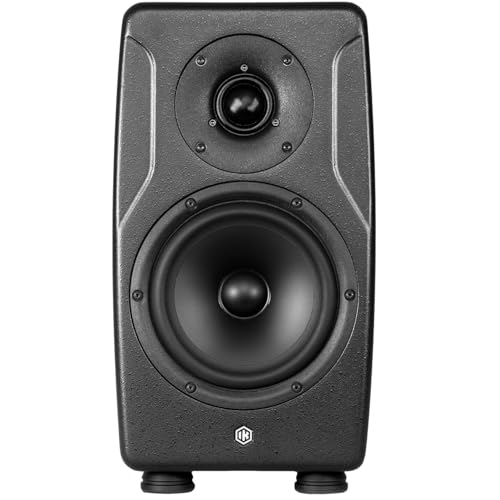
- Built-in ARC room calibration with measurement mic
- Linear-phase, time-coherent monitoring
- ARC X emulation and 150W amplification
Best For: Professional mixing, mastering, and immersive audio
Best Desktop Pick
ADAM Audio D3V Active Desktop Monitors
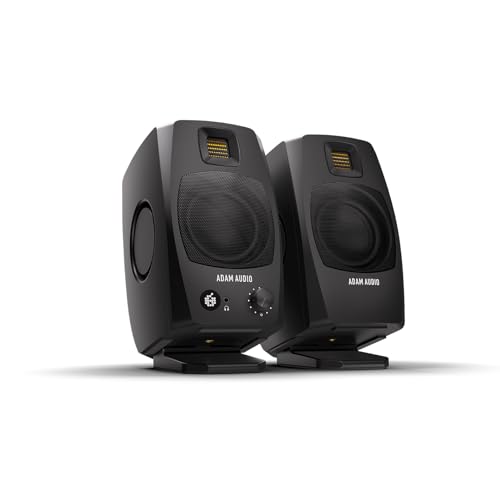
- DSP controls address placement-related acoustic issues
- USB-C, 1/4-inch TRS, and RCA connectivity
- Compact pair with D-ART tweeters and stands
Best For: Computer-based production and compact desktop studios
Best Value Pair
Yamaha HS5 Powered Studio Monitor Pair

- Uncolored monitoring presentation
- Bi-amplified 5-inch nearfield design
- Balanced XLR and TRS inputs
Best For: Home studios using external treatment or calibration
Best Compact Calibrated Monitor

- Built-in ARC room correction
- 36 Hz–32 kHz frequency range
- X-MONITOR reference emulation
Best For: Small desks, mobile setups, and computer-based production
Wide-Sweet-Spot Workhorse

- 6.55-inch woofer for deep lows
- Wide EBM waveguide sweet spot
- Acoustic controls for room tailoring
Best For: Home and project-studio mixing with flexible placement needs
Flexible DSP Value Pick

- DSP targets a flat response
- Boundary EQ adapts to placement
- 80W bi-amped design with 115dB max SPL
Best For: Home studios needing flexible placement and strong output
Wide-Dispersion Professional Choice
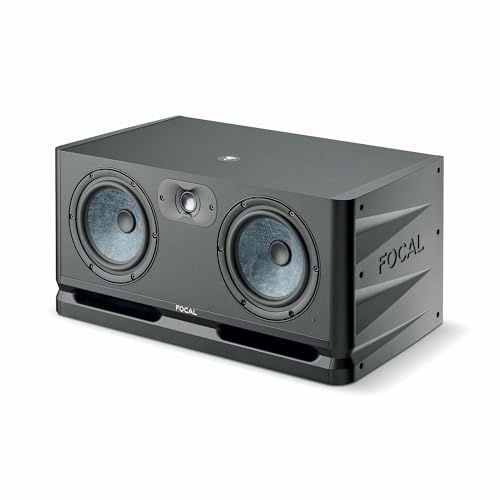
- Wide dispersion across the room
- Neutral Slatefiber cone with low distortion
- Three-source connectivity via XLR, TRS, and RCA
Best For: Professional studios prioritizing coverage and dynamics
Compact Room Control
Yamaha HS3 Powered Studio Monitor Pair

- Compact 3.5-inch two-way stereo pair
- Room control and high-trim response controls
- RCA, USB, and XLR connectivity
Best For: Small desktop studios and video-editing setups
Wide Sweet Spot
JBL 305P MkII Studio Monitor Pair

- 5-inch two-way powered monitor pair
- Boundary EQ and HF Trim for room adjustment
- Image Control Waveguide with wide sweet spot
Best For: Production, podcasting, and sound-design work
Accurate Mix Translation
Mackie MR524 Powered Studio Monitor

- 5-inch woofer with 1-inch silk-dome tweeter
- Ultra-wide dispersion and logarithmic waveguide
- 65 watts of bi-amplified Class A/B power
Best For: Mix-focused monitoring with a broad listening sweet spot
Best Overall – IK Multimedia iLoud Precision 6 MKII
If you want studio monitors with room correction for serious mixing, mastering, or immersive audio, the iLoud Precision 6 MKII combines ARC calibration with a linear-phase design. Its 6.5-inch woofer, graphene tweeter, and 150-watt amplification are suited to demanding nearfield work.
Best For: Professional studios, critical mixing, mastering, and Atmos or surround setups.
Pros:
- Built-in ARC calibration adapts the monitor to the room using the included measurement microphone.
- Linear-phase and time-coherent playback supports accurate mix translation.
- ARC X adds target curves, voicing adjustments, and emulation of more than 20 monitor and consumer-device profiles.
- Offers a 45 Hz–30 kHz ±1 dB response, 150 watts of Class-D amplification, and mounting options.
Cons:
- Its professional feature set may be more than casual desktop listeners need.
- The larger cabinet and 16.7-pound weight require more space than compact monitors.
The Precision 6 MKII is the most complete option here for buyers who want integrated calibration, detailed response, and advanced reference-monitor emulation in one professional monitor.
Best Desktop Pick – ADAM Audio D3V Active Desktop Monitors
The ADAM Audio D3V is a compact choice for buyers seeking studio monitors with room correction on a desk. Its DSP-powered placement controls address common acoustic issues, while USB-C connectivity, D-ART tweeters, and included angled stands make it convenient for computer-based production.
Best For: Songwriters, producers, desktop setups, and listeners who need a compact active pair.
Pros:
- DSP-powered switches help compensate for common speaker-placement and room-acoustic issues.
- USB-C connects directly to computers and mobile devices.
- D-ART tweeters provide detailed high-frequency reproduction, while passive radiators extend bass to 45 Hz.
- Includes 15-degree desktop stands and microphone-stand mounting points.
Cons:
- The 3.5-inch woofers provide less low-end scale than larger studio monitors.
- Room adjustment is placement-focused DSP control rather than the full microphone-based calibration offered by some larger monitors.
Choose the D3V when desk space, USB-C convenience, and straightforward acoustic adjustment matter more than maximum bass extension or full-room measurement.
Best Value Pair – Yamaha HS5 Powered Studio Monitor Pair
The Yamaha HS5 pair is a practical monitoring foundation for music production, especially if you want a familiar, uncolored presentation. These monitors do not include microphone-based room correction, but their balanced inputs and bi-amplified design make them a solid choice when paired with external acoustic treatment or calibration.
Best For: Home studios and producers who prioritize a clear, uncolored reference over built-in correction.
Pros:
- Designed to emphasize sonic purity without coloring the original sound.
- Bi-amplified 5-inch woofer and 1-inch dome tweeter provide a focused nearfield presentation.
- Balanced XLR and TRS inputs accept balanced or unbalanced signals.
- The listing includes two HS5 monitors.
Cons:
- No built-in room-correction system is listed, so calibration requires external tools or treatment.
- The 54 Hz low-frequency specification may not satisfy users needing extended sub-bass.
- Placement and acoustic treatment remain important for accurate results.
The HS5 is best viewed as a straightforward, reliable monitor pair rather than an all-in-one room-correction solution. Add external calibration if room response is a major concern.
Best Compact Calibrated Monitor – IK Multimedia iLoud MTM MKII
The iLoud MTM MKII is a compact option for studio monitors with room correction, offering built-in ARC calibration in a small desktop-friendly enclosure. It combines a 36 Hz–32 kHz range, linear-phase time alignment, and X-MONITOR emulation for flexible monitoring in small rooms or mobile setups.
Best For: Compact desks, computer-based production, DJs, and surround or mixing setups.
Pros:
- Built-in ARC calibration helps optimize response for the listening room.
- Linear-phase time alignment can reduce fatigue during extended sessions.
- X-MONITOR software emulates multiple monitors and reference systems.
- Includes an adjustable tabletop stand and microphone-stand mounting point.
Cons:
- The calibration microphone is sold separately.
- This listing is for a single speaker, so stereo users need two units.
- The compact plastic enclosure may not provide the same scale as larger professional monitors.
For small workspaces, the MTM MKII offers an appealing balance of calibration, low-end extension, and reference emulation. Factor in the separate microphone and additional speaker cost when building a stereo pair.
Wide-Sweet-Spot Workhorse – PreSonus Eris E7 XT
PreSonus Eris E7 XT 2-Way Active Studio Monitor with EBM Waveguide (Pack of 1)
Check Price On AmazonThe PreSonus Eris E7 XT is a practical choice for anyone seeking studio monitors with room correction features. Its acoustic tuning controls let you adjust level, high-pass filtering, low- and high-frequency trim, and acoustic space to better suit your mixing environment.
Best For: Home and project-studio mixing where flexible placement and a wide listening sweet spot matter.
Pros:
- 6.55-inch woven-composite woofer supports deep low frequencies.
- EBM waveguide creates a wide sweet spot and solid imaging.
- Multiple acoustic controls help tailor the monitor to your room.
- Includes Studio One Prime and the Studio Magic plug-in suite.
Cons:
- Sold as a single monitor, so a stereo setup requires two units.
- Its 6.5-inch format may be more speaker than smaller desktop spaces need.
The Eris E7 XT stands out for combining a large woofer, smooth silk-dome tweeter, and useful room-tuning controls. It is a strong fit when you want placement flexibility without giving up a broad sweet spot.
Flexible DSP Value Pick – Kali Audio LP-6 V2
The Kali Audio LP-6 V2 is a compelling option among studio monitors with room correction, using updated DSP and boundary EQ to help maintain balanced output on a desk, stand, or near a wall. Its bi-amped 80-watt design also provides substantial headroom for production work.
Best For: Home-recording setups that need placement flexibility, low noise, and strong output at a value-oriented price.
Pros:
- Updated DSP is designed for a flat, unaltered frequency response.
- Boundary EQ supports placement on stands, against walls, or on desks.
- Front port and noise-reduction improvements help minimize turbulence and hiss.
- 80 watts of bi-amped power and up to 115dB max SPL provide strong output.
Cons:
- Sold as a single speaker rather than a stereo pair.
- The 6.5-inch monitor may be larger than necessary for very compact workspaces.
With DSP-based voicing, boundary adjustment, and professional TRS, RCA, and XLR inputs, the LP-6 V2 offers useful room-placement flexibility. It is especially appealing when accurate monitoring and output matter more than a compact footprint.
Wide-Dispersion Professional Choice – Focal Alpha-Twin-EVO
The Focal Alpha-Twin-EVO is a substantial active monitor for professional studio monitoring. While its supplied features emphasize wide dispersion rather than dedicated room-correction controls, its consistent tonal balance across volume levels can help support reliable listening throughout a room.
Best For: Professional or larger studio environments where dynamics, wide coverage, and multiple source connections are priorities.
Pros:
- Wide dispersion helps maintain a consistent sound across the room.
- Slatefiber cone is designed for neutrality and low distortion.
- Identical tonal balance at low and high volume supports flexible monitoring.
- Accepts up to three audio sources through XLR, TRS, and RCA connections.
Cons:
- Its tall, 26.9-pound cabinet requires substantial placement space.
- Sold as a single monitor, so stereo monitoring requires a second unit.
- The supplied notes do not list dedicated acoustic room-correction controls.
The Alpha-Twin-EVO prioritizes dynamics, dispersion, and dependable tonal behavior over compact dimensions. It makes the most sense for serious monitoring spaces where its larger enclosure and broad coverage can be properly accommodated.
Compact Room Control – Yamaha HS3 Powered Studio Monitor Pair
The Yamaha HS3 is a compact stereo pair for desktop setups where space matters. Among studio monitors with room correction, it offers practical room control and high-trim response controls for tailoring playback, along with RCA, USB, and XLR connectivity.
Best For: Desktop music production, video editing, and small workspaces that need compact monitors with basic room-adjustment controls.
Pros:
- Sold as a matched pair for straightforward stereo monitoring.
- Compact 3.5-inch woofer and 0.75-inch dome tweeter design suits smaller desks.
- Room control and high-trim response controls help adapt the sound to the listening space.
- Offers RCA, USB, and XLR connectivity for computers and other devices.
Cons:
- The 70 Hz–22 kHz (-10 dB) response and 26 W + 26 W output are more limited than larger monitors.
- Not waterproof and intended for corded-electric use.
The HS3 prioritizes convenience and a small footprint over maximum low-end extension. It is a sensible option for close-range desktop monitoring when adjustable response controls are more important than high output.
Wide Sweet Spot – JBL 305P MkII Studio Monitor Pair
The JBL 305P MkII pair combines 5-inch woofers with an Image Control Waveguide designed for precise imaging and a broad listening sweet spot. For shoppers comparing studio monitors with room correction, its Boundary EQ and HF Trim provide practical low- and high-frequency adjustments for different rooms.
Best For: Music production, podcasting, and cinematic sound design where wide imaging, flexible placement controls, and stronger output are priorities.
Pros:
- Includes two 5-inch, two-way powered reference monitors.
- Image Control Waveguide supports precise imaging and a wide sweet spot.
- Boundary EQ and HF Trim help tailor low and high frequencies to the room.
- Dual 41-watt Class-D amplifiers and a Slip Stream port support dynamic playback and deep bass.
Cons:
- The pair is larger and heavier than compact desktop monitors.
- Connectivity is limited to XLR and 1/4-inch TRS inputs.
The 305P MkII is the most feature-rich room-adjustment choice in this group. Its 5-inch drivers, broad sweet spot, and Boundary EQ make it a strong fit for producers who need consistent monitoring across a wider listening position.
Accurate Mix Translation – Mackie MR524 Powered Studio Monitor
The Mackie MR524 is a single 5-inch powered monitor built for mix accuracy and translation. Its logarithmic waveguide, ultra-wide dispersion, and Class A/B amplification make it a practical candidate for studio setups seeking a broad listening area, although the supplied specifications do not list dedicated room-correction controls.
Best For: Producers who want a detailed single monitor with wide dispersion and a 5-inch woofer for professional-style desktop or studio monitoring.
Pros:
- 5-inch polypropylene woofer and 1-inch silk-dome tweeter provide a two-driver design.
- Ultra-wide dispersion supports a larger stereo imaging and listening sweet spot.
- Logarithmic waveguide is designed for mix translation and high-frequency detail.
- 65 watts of bi-amplified Class A/B power offers useful headroom.
Cons:
- Sold as a single monitor, so a stereo setup requires two units.
- The supplied notes do not identify dedicated room-correction or response-adjustment controls.
- Connectivity is limited to XLR and 1/4-inch inputs.
The MR524 emphasizes dispersion, imaging, and mix translation rather than built-in room tuning. Choose it when those qualities matter most and you are comfortable handling room treatment or correction separately.
How We Picked the Best Studio Monitors with Room Correction
We selected these monitors across several practical categories: compact desktop speakers, affordable nearfields, established project-studio models, and higher-end monitors designed for more detailed monitoring. We considered driver size, amplification, cabinet design, connectivity, placement flexibility, stereo-pair availability, and suitability for music production, mixing, editing, and general critical listening.
Room correction received special attention because it can help compensate for some placement and acoustic problems. It does not replace treatment or careful positioning, but it can make a calibrated setup more predictable.
Quick Comparison
- Best for built-in room correction: IK Multimedia iLoud Precision 6 MKII and iLoud MTM MKII.
- Best compact desktop choices: ADAM Audio D3V and Yamaha HS3.
- Best affordable nearfields: Yamaha HS5, Kali Audio LP-6 V2, JBL 305P MkII, and Mackie MR524.
- Best for a larger, more expansive presentation: PreSonus Eris E7 XT and Focal Alpha-Twin-EVO.
Key Buying Factors for Studio Monitors with Room Correction
Room Size and Listening Distance
Choose the driver size and output level according to your room and listening position. Five-inch monitors are often easier to manage in small rooms, while six- to seven-inch models can provide deeper bass and greater headroom. Larger speakers are not automatically better if your room cannot support their low-frequency output.
Correction Features and Calibration
Built-in calibration can address broad response issues caused by the room, but results depend on accurate measurement and correct placement. Look for a complete workflow that may include a measurement microphone, software, onboard presets, or app-based control. Keep correction moderate and verify mixes on headphones and other playback systems.
Placement, Dispersion, and Acoustic Treatment
Place monitors symmetrically, form an approximate equilateral triangle with your listening position, and aim tweeters toward your ears. Front- or rear-ported designs may behave differently near walls. Wide dispersion can create a larger sweet spot, while controlled dispersion may reduce reflections in a treated room.
Connectivity and Workflow
Check whether the monitor accepts balanced inputs such as XLR or TRS, and confirm that your audio interface has compatible outputs. Desktop users should also consider footprint, controls, standby behavior, and whether a subwoofer or separate bass management system may be added later.
Who Should Buy Which Studio Monitors with Room Correction?
Choose the iLoud Precision 6 MKII or iLoud MTM MKII if room correction and a compact calibration workflow are central to your setup. Choose the ADAM D3V or Yamaha HS3 for a small desk, short listening distance, or limited space.
Choose the Yamaha HS5, JBL 305P MkII, Mackie MR524, or Kali LP-6 V2 if you want dependable project-studio monitoring at a more accessible price. Choose the Eris E7 XT when you want more low-end reach and a broad listening presentation, or the Focal Alpha-Twin-EVO when you need a larger, more ambitious monitoring system and have the room and budget to support it.