
Choosing the right 3D scanner for clay models can save hours in cleanup, preserve fine sculpting detail, and make digitizing prototypes far less frustrating.
Below, we focus on scanners that balance accuracy, ease of use, and reliable surface capture for clay, so you can match the tool to your studio workflow.
Best 10 3d Scanner for Clay Models Picks for 2026
Precision Color Capture
Revopoint POP3 Plus 3D Scanner
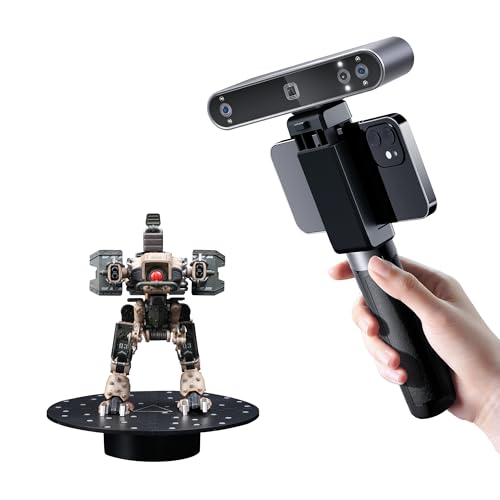
- 20-micron accuracy and improved precision
- Full-color scans with RGB camera and flash LEDs
- Wi-Fi 6, USB-C, and broad file export support
Best For: Medium-size clay models, color capture, and general 3D printing workflows
Fine Detail Small Format

- Up to 0.02 mm accuracy for tiny surface details
- Blue LED source tuned for small-format objects
- JMStudio includes tracking, correction, and export tools
Best For: Small clay models, indoor tabletop scanning, and detail-focused workflows
Industrial Detail Scanner

- Up to 0.01 mm precision and 0.02 mm accuracy
- Multiple modes for tricky surfaces and fine features
- Auto turntable and RGB color scanning
Best For: Advanced clay-model scanning, measurement, and professional prototyping
Entry-Level Medium Format

- 0.07 mm accuracy and 0.10 mm resolution
- Markerless AI tracking helps recover from movement
- JMStudio streamlines scanning, editing, and optimization
Best For: Beginners scanning medium-sized clay models for printing or modeling
Ultra-Fast Detail Capture
Creality Raptor Pro for Precision Clay Scans

- 0.02mm lab-condition accuracy
- 60 FPS scanning with marker alignment
- Wireless kit supports detailed object capture
Best For: high-precision clay sculptures and fast multi-scan workflows
Portable All-in-One
Revopoint MIRACO Pro for Clay Models

- Standalone scanning and editing on board
- 0.02mm precision with 48MP color capture
- Near-mode and Far-mode for flexible object sizes
Best For: mobile users who want a cable-free scanner for detailed clay models
Quiet Lightweight Option
3DMakerpro Moose Lite for Clay Scans
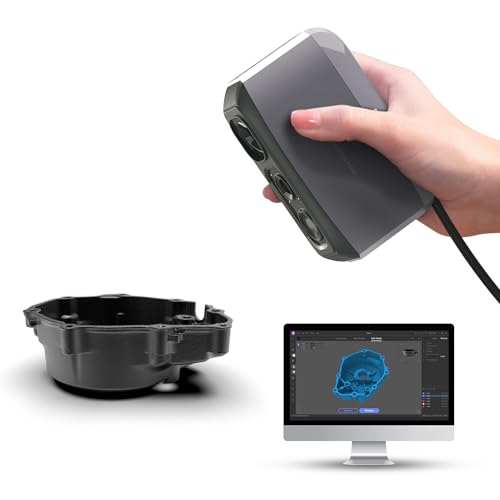
- 0.05mm accuracy with 0.1mm resolution
- 250g lightweight body with quiet operation
- AI tracking and JMStudio simplify workflow
Best For: lightweight handheld scanning of detailed clay models
Beginner-Friendly Wireless Pick

- WiFi 6 wireless scanning across multiple platforms
- 0.1mm accuracy with 24-bit full-color capture
- Lightweight 105g body with travel-ready kit
Best For: Beginners and DIY creators scanning medium-to-large clay models
High-Detail Mid-Size Scanner

- 0.05mm accuracy with blue light scanning
- AI tracking plus JMStudio workflow tools
- Lightweight, quiet design for portable use
Best For: Creators who want detailed scans of clay models and medium objects
Pro-Level Precision Scanner

- 0.02mm accuracy with blue laser and NIR scanning
- Fast up to 60fps with anti-shake tracking
- Wide size support from tiny parts to large objects
Best For: Advanced users scanning clay models that need the highest detail
Precision Color Capture – Revopoint POP3 Plus 3D Scanner
If you need a 3d scanner for clay models that balances detail, speed, and portability, the Revopoint POP3 Plus is a practical all-around option. It’s built for medium-sized objects and offers full-color scanning, so it can capture both surface form and visible texture for printing, design, or archiving.
Best For: Hobbyists and creators who want a lightweight, color-capable scanner for medium-size clay models and general 3D printing workflows.
Pros:
- Up to 20 microns of accuracy with improved precision for finer model capture.
- Optical zoom modes help increase point cloud detail on small features.
- Full-color scanning with HD RGB camera and flash LED lighting.
- Wi-Fi 6 or USB-C connectivity plus broad file export support.
Cons:
- Software is only compatible with x86_64 architecture.
- Best suited to medium-sized objects rather than very small minis.
Overall, the POP3 Plus is a strong choice if you want a flexible clay-model scanner that’s easy to move between devices and can feed directly into common 3D printing and modeling software.
Fine Detail Small Format – 3DMakerpro Seal Lite
The 3DMakerpro Seal Lite is a compact 3d scanner for clay models when you need very fine detail on smaller pieces. Its blue LED light source and small-format focus make it better suited to indoor scanning of compact sculptures, maquettes, and test pieces.
Best For: Small clay models, indoor tabletop scanning, and users who care most about tiny surface details.
Pros:
- Claims up to 0.02 mm accuracy for capturing tiny dents and edge textures.
- Designed for objects from 10 to 300 mm with a recommended 180–280 mm working distance.
- Scan-back and anti-shake features improve handheld stability.
- JMStudio offers visual tracking, error correction, and export to common formats.
Cons:
- Mono texture only, so it does not provide full color scanning.
- Indoor use is suggested, and there is a learning curve for new users.
- Requires a relatively powerful PC to run smoothly.
If your clay work is small and detail-heavy, the Seal Lite is a focused scanner that prioritizes surface fidelity over versatility. It’s a good fit for users willing to learn the workflow to get refined results.
Industrial Detail Scanner – Revopoint MetroX Pro
For a 3d scanner for clay models where precision matters most, the Revopoint MetroX Pro brings industrial-grade capture to the table. Its blue laser and structured-light modes are designed for high-detail scanning, especially when you want accurate geometry from complex or reflective surfaces.
Best For: Advanced users who want high-precision scans of clay models for measurement, prototyping, or professional modeling.
Pros:
- Single-frame precision up to 0.01 mm and accuracy up to 0.02 mm.
- Multiple scan modes for flat, shiny, dark, or feature-rich surfaces.
- Auto turntable supports one-click automated scanning.
- HD RGB camera adds color-accurate scans in auto turntable mode.
Cons:
- Larger and heavier than typical consumer handheld scanners.
- Revo Design and Revo Measure are sold separately.
- Some workflow features are Windows-only.
The MetroX Pro is the most capable option here if you need top-tier detail and measurement-ready output. It’s especially compelling for clay work that will be evaluated, refined, or reverse-engineered.
Entry-Level Medium Format – 3DMakerpro Fox
The 3DMakerpro Fox is a beginner-friendly 3d scanner for clay models when you want a straightforward path into handheld scanning. It targets medium-format objects and combines moderate precision with AI visual tracking to make it easier to keep scanning even if your hand movement is a little inconsistent.
Best For: Beginners and hobbyists scanning medium-sized clay models for printing, modeling, or basic inspection.
Pros:
- 0.07 mm accuracy and 0.10 mm resolution for useful model detail.
- Markerless AI visual tracking helps relock onto the object after movement.
- JMStudio handles scanning, editing, and optimization in one workflow.
- Accessible medium-format scanner for beginners and hobbyists.
Cons:
- Less precise than the higher-end scanners in this roundup.
- No full-color scanning is mentioned in the supplied notes.
Fox is a sensible starting point if you’re scanning clay pieces and want a less intimidating setup. It won’t match the premium scanners for ultra-fine detail, but it does offer a solid balance of usability and output quality.
Ultra-Fast Detail Capture – Creality Raptor Pro for Precision Clay Scans
If you need a 3d scanner for clay models that can capture fine surface texture quickly, the Creality Raptor Pro is built for high-detail work. Its 0.02mm lab-condition accuracy, blue laser lines, and marker-based alignment make it a strong fit for small sculpted forms and multi-pass scans that need clean stitching.
Best For: Users who want very high precision and fast scanning for detailed clay sculptures
Pros:
- Up to 0.02mm accuracy in laboratory conditions
- Scans at up to 60 FPS and 660,000 points per second
- Supports objects from 5mm to 2000mm in size
- Includes wireless scanning with the Scan Bridge accessory
Cons:
- Best accuracy is specified in laboratory conditions
- Full-color scanning is supported, but setup may be more involved than simple entry-level scanners
- Package is relatively large and heavy compared with compact handheld options
For clay models with intricate detail, this scanner emphasizes speed, precision, and flexible object sizing over simplicity. If your workflow values accurate surface capture and easy alignment across multiple scans, it is a compelling option.
Portable All-in-One – Revopoint MIRACO Pro for Clay Models
The Revopoint MIRACO Pro is a strong 3d scanner for clay models if you want an all-in-one setup with no computer tether. It combines on-board scanning, editing, and color capture with 0.02mm single-frame precision, making it practical for detailed clay work that benefits from portable, cable-free operation.
Best For: Creators who want a portable, standalone scanner with built-in editing
Pros:
- No cables or computer needed for scanning and editing
- Up to 0.02mm single-frame precision
- 48MP RGB camera and Flash LED system for color capture
- Near-mode and Far-mode support small details and larger objects
Cons:
- Revo Design software is sold separately
- 2-hour battery life may be limiting for longer sessions
- Professional CAD workflow features are tied to paid software and Windows-only support
This model stands out for convenience and versatility, especially if you scan clay pieces away from a desk. It balances portability, onboard control, and detailed capture in a compact package.
Quiet Lightweight Option – 3DMakerpro Moose Lite for Clay Scans
If you’re looking for a practical 3d scanner for clay models without a lot of bulk, the 3DMakerpro Moose Lite focuses on lightweight handling and detailed capture. With 0.05mm accuracy, AI tracking, and software that combines scanning, editing, and optimization, it is aimed at making handheld scanning more manageable for everyday projects.
Best For: Makers who want a lightweight handheld scanner for detailed clay projects
Pros:
- 0.05mm accuracy and 0.1mm resolution for detailed models
- Lightweight at 250g and designed to run quietly
- AI tracking and point-cloud processing simplify scanning
- Works in darker environments with 9-level light adjustment
Cons:
- 10 FPS scanning speed is slower than higher-end rivals
- Smart Grip for phone scanning is optional and sold separately
- Plastic construction may feel less premium than metal-bodied models
This is a balanced choice when ease of handling matters as much as detail. It is especially appealing for smaller clay objects, quieter workspaces, and users who want straightforward software integration.
Beginner-Friendly Wireless Pick – Creality CR-Scan Ferret Pro
If you want a 3d scanner for clay models that’s easy to start using, the Creality CR-Scan Ferret Pro is built around simple setup and portable wireless scanning. Its 0.1mm accuracy, full-color capture, and anti-shake tracking make it a practical choice for medium-to-large clay pieces, especially when you want a straightforward workflow across phones, PCs, and Mac systems.
Best For: Beginners, DIY creators, and 3D printing users who want a lightweight wireless scanner for clay models and other medium-sized objects.
Pros:
- WiFi 6 wireless scanning works across Windows, macOS, Android, and iOS.
- Up to 0.1mm accuracy with 24-bit full-color scanning and anti-shake tracking.
- Lightweight 105g design makes it easy to carry for studio or on-the-go use.
- Includes a full accessory kit with tripod, power bank, phone holder, and case.
Cons:
- Not suitable for very small or highly detailed items like jewelry or precision parts.
- Best results avoid reflective, transparent, or very dark surfaces.
- Requires compatible system specs, especially for smoother performance.
Overall, the Ferret Pro is a user-friendly option if you need a flexible 3d scanner for clay models without a steep learning curve. It favors convenience and portability over ultra-fine detail, which makes it well matched to larger handmade forms.
High-Detail Mid-Size Scanner – 3DMakerpro Moose Lite
The 3DMakerpro Moose Lite is a strong pick if you need a 3d scanner for clay models with fine surface detail. It combines blue light scanning, AI visual tracking, and 0.05mm accuracy, which helps preserve texture and shape on medium objects when you want a cleaner model for printing or display.
Best For: Users who want higher precision for clay models, detailed crafts, and other medium-sized objects.
Pros:
- 0.05mm accuracy and 0.1mm resolution support detailed model capture.
- AI visual tracking and JMStudio software simplify scanning, editing, and optimization.
- Enhanced vertical scanning helps with complex shapes and intricate structures.
- Lightweight, quiet design with no fan noise and easy portability.
Cons:
- Scan range is focused on 15mm to 1500mm objects, so it is not for very large pieces.
- Plastic construction is less rugged than the metal-bodied Moose version.
- Best suited to users comfortable with software-assisted workflows.
For clay model scanning, the Moose Lite stands out when detail matters more than maximum size coverage. Its precision-focused hardware and software make it a sensible step up for makers who want more refined results.
Pro-Level Precision Scanner – Creality CR-Scan Raptor
If your priority is capturing clay models with more professional-grade detail, the Creality CR-Scan Raptor is the most advanced option here. Its blue laser and NIR system, 0.02mm accuracy, and fast scanning make it well suited to detailed forms, textured surfaces, and bigger objects when you want sharp geometry and reliable tracking.
Best For: Advanced users, makers, and professionals scanning clay models, miniatures, and larger detailed objects.
Pros:
- 0.02mm accuracy with 7 parallel blue laser lines for fine detail.
- Supports a wide object range from 5×5×5mm up to 2000×2000×2000mm.
- Up to 60fps scanning with anti-shake tracking and autofocus stability.
- 24-bit full-color capture with lighting designed to improve texture realism.
Cons:
- More demanding system requirements than the other options.
- Best experience may require stronger Windows or macOS hardware.
- Likely more scanner than casual beginners need for simple clay projects.
The Raptor is the strongest choice when scan precision is the top concern. For clay models that need crisp edges, reliable tracking, and more professional output, it offers the most capable feature set in this group.
How We Picked the Best 3d Scanner for Clay Models
For a 3d Scanner for Clay Models, the most important factors are fine-detail accuracy, stable tracking on matte or uneven surfaces, and a workflow that does not slow down the sculpting process. We prioritized scanners that offer strong reported precision, practical handheld usability, and support for medium-to-small objects where clay maquettes and sculptures are most common.
We also looked at setup simplicity, portability, scan speed, and whether the scanner is better suited to textured organic shapes or to cleaner, more technical forms. That helps separate everyday studio tools from niche hardware.
Quick Comparison
In this roundup, some models are better for smaller clay studies and miniatures, while others are built for larger busts, props, or medium-format sculptures. Blue light and laser systems generally offer stronger detail capture, while wireless or all-in-one designs can improve convenience when moving around a sculpture. If you work across multiple clay sizes, flexibility matters as much as raw precision.
Key Buying Factors for a 3d Scanner for Clay Models
Accuracy and Detail Capture
Look for stated accuracy in the 0.02mm to 0.05mm range if you need clean digital preservation of sculpted texture, finger marks, and tool lines. Higher accuracy is especially useful when the scan will be used for 3D printing, digital refinement, or archival documentation.
Surface Handling and Tracking
Clay surfaces can be soft in color, low in reflectivity, and full of subtle contours. Good tracking, anti-shake features, and multi-line scanning help reduce dropouts and keep scans aligned on organic forms.
Object Size and Working Distance
Choose a scanner that matches the size of the clay pieces you actually make. Small-format models need close-range detail, while larger sculptures benefit from a wider capture volume and easier movement around the object.
Speed, Portability, and Workflow
Faster scan rates can be helpful in a studio setting, but speed should not come at the expense of detail. If you scan frequently, portability, wireless operation, and all-in-one systems may be worth paying for because they shorten setup and teardown time.
Who Should Buy Which 3d Scanner for Clay Models?
Miniature sculptors and detail-focused artists should lean toward high-accuracy small-format options. Makers who digitize busts, character sculpts, or medium props may prefer a balanced handheld scanner with stronger tracking and a more forgiving workflow. If you want a versatile studio tool for both scanning and moving between workstations, all-in-one or wireless models are the most convenient choice.
For the best results, match the scanner to your clay model size, the level of detail you need to preserve, and how often you plan to scan. That combination matters more than any single specification.