
Choosing the right 3D scanner for reverse engineering can save hours in cleanup, measurement, and CAD rebuilds.
This roundup focuses on scanners that balance accuracy, tracking stability, speed, and practical workflows for real-world parts.
Best 10 3d Scanner for Reverse Engineering Picks for 2026
Industrial Metrology Pick
Revopoint MetroX Pro Blue Laser Scanner

- 0.01 mm precision for high-detail parts
- 4 scan modes, including auto turntable
- Works on shiny or dark surfaces without spray in supported modes
Best For: Precision reverse engineering and industrial measurement
Speed-Focused Hybrid Pick
Creality CR-Scan Raptor Blue/NIR Scanner

- 0.02 mm accuracy with thin 0.1 mm laser lines
- Blue laser plus NIR modes for flexible scanning
- Up to 60 fps for faster capture
Best For: Fast, flexible scanning across small to large objects
Scan-to-CAD Workhorse
Revopoint MetroX Blue Laser Scanner

- 0.02 mm accuracy for detailed reverse engineering
- 4 modes, including automated turntable scanning
- Free software with export tools for CAD workflows
Best For: Scan-to-CAD, inspection, and mechanical parts
Wireless Precision Upgrade
Creality Raptor Pro with Scan Bridge

- 0.02 mm accuracy in lab conditions
- Wireless scanning support for easier workflows
- 60 fps capture with marker-based alignment
Best For: Convenient high-precision reverse engineering
Precision AI Scanner
Revopoint POP 4 for 3D Printing & Reverse Engineering
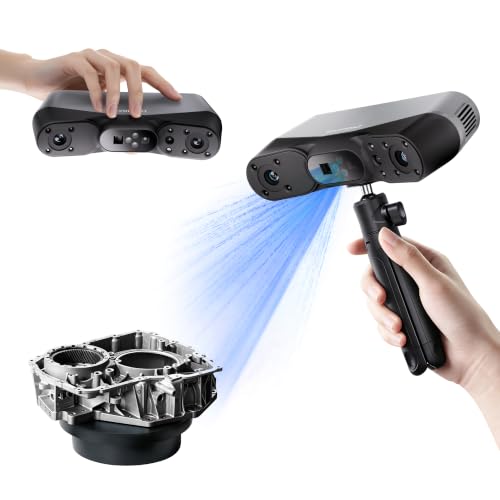
- Up to 0.03 mm single-frame accuracy
- Five scan modes for varied surfaces and sizes
- Wi-Fi 6 and 4-hour battery grip for mobile scanning
Best For: Versatile reverse engineering, 3D printing prep, and outdoor scanning
High-Speed Laser Scanner

- Up to 0.02 mm accuracy and 660,000 points/sec
- Scans black, metallic, and transparent glass without spray
- Works with major CAD and modeling software
Best For: Fast reverse engineering and challenging materials
Ultra-Fine Industrial Scanner

- Up to 0.01 mm single-frame precision
- Five modes for fine detail and marker-free scanning
- No-spray capture for black, glossy, and metal parts
Best For: Precision reverse engineering and industrial inspection
Portable Hybrid Scanner for Flexible Reverse Engineering

- Up to 0.05 mm accuracy and 0.03 mm precision
- Dual structured-light and laser scanning modes
- WiFi 6 wireless scanning and 190g portable body
Best For: Portable reverse engineering and scan-to-CAD work
High-Precision Blue Laser Scanner for Metrology Work

- Up to 0.01 mm precision and 0.02 mm accuracy
- Five modes including deep-hole and auto turntable scanning
- Blue laser capture works without scanning spray
Best For: Precision reverse engineering and metrology
AI-Assisted All-Purpose Scanner for Large and Small Parts

- Up to 0.03 mm single-frame accuracy
- Five scan modes for parts from tiny to large
- AI segmentation and wireless scanning on Windows
Best For: Mixed-size reverse engineering with streamlined cleanup
Industrial Metrology Pick – Revopoint MetroX Pro Blue Laser Scanner
If you need a 3d scanner for reverse engineering, the Revopoint MetroX Pro is built for high-detail work on parts that demand metrology-level capture. Its blue laser system, multiple scan modes, and turntable automation make it a strong fit for precise modeling, inspection, and scan-to-CAD workflows.
Best For: Users who want industrial-grade accuracy for reverse engineering, inspection, and precision modeling.
Pros:
- Up to 0.01 mm single-frame precision and 0.02 mm accuracy for detailed measurements.
- Four scan modes, including cross-line lasers, parallel lines, structured light, and auto turntable scanning.
- Handles shiny or dark surfaces without scanning spray in supported laser modes.
- Supports feature, marker, and global marker tracking for different object types.
Cons:
- Revo Design and Revo Measure are sold separately.
- Those paid tools are Windows-only.
Overall, MetroX Pro is the most feature-rich option here for buyers who care most about precision and workflow depth. It is especially compelling if you want scan data ready for reverse engineering or quality inspection with minimal friction.
Speed-Focused Hybrid Pick – Creality CR-Scan Raptor Blue/NIR Scanner
The Creality CR-Scan Raptor is a practical 3d scanner for reverse engineering when you want a mix of high precision and faster capture. Its blue laser and NIR modes let you switch between detailed scans and marker-free use cases, which makes it versatile for parts, faces, bodies, and artifacts.
Best For: Buyers who want a fast scanner with flexible blue-light and infrared modes.
Pros:
- Up to 0.02 mm accuracy with 7 parallel blue laser lines as thin as 0.1 mm.
- 2-in-1 blue light and NIR scanning for both marker-based and marker-free workflows.
- Up to 60 fps in blue light mode and 20 fps in infrared mode.
- Supports objects from 5 mm to 2000 mm, covering tiny parts to large items.
Cons:
- Requires a high-performance computer to run well.
- PC requirements are specific for both Windows and macOS.
This is a flexible choice if you need speed and range without giving up accuracy. It stands out for users who scan many object sizes and want the option to move between detailed laser scanning and more general infrared capture.
Scan-to-CAD Workhorse – Revopoint MetroX Blue Laser Scanner
The Revopoint MetroX is a strong 3d scanner for reverse engineering if you want metrology-style capture with a focus on CAD-friendly output. Its blue laser system, automated turntable mode, and export options are geared toward mechanical parts, molds, and other detailed objects.
Best For: Reverse engineering, quality control, and CAD workflows that need accurate scan data.
Pros:
- Up to 0.02 mm accuracy and 0.01 mm precision for detailed scanning.
- Four scan modes, including cross lines, parallel lines, full-field, and auto turntable.
- Can scan dark or shiny surfaces without spray in supported laser modes.
- Includes free software with point cloud, meshing, editing, import, and export tools.
Cons:
- Revo Design is powered by Quicksurface and sold separately as part of the workflow.
- The software is only compatible with x86_64 architecture.
- USB 3.0 is recommended for best performance.
MetroX is especially appealing if you want a scanner that fits a scan-to-CAD process rather than just capturing surface data. The included calibration board and broad file support add confidence for repeatable work.
Wireless Precision Upgrade – Creality Raptor Pro with Scan Bridge
If you want a 3d scanner for reverse engineering with a stronger emphasis on workflow convenience, the Creality Raptor Pro pairs high-precision scanning with wireless accessories. It is designed for detailed capture, fast frame rates, and easy alignment, which helps when scanning parts for replication or reconstruction.
Best For: Users who want accurate scanning with wireless convenience and easy multi-scan alignment.
Pros:
- Up to 0.02 mm accuracy in laboratory conditions.
- Scans at up to 60 fps and 660,000 points per second.
- Wireless scanning support adds convenience during capture.
- Marker-based alignment helps stitch multiple scans together.
Cons:
- The accuracy rating is specified in laboratory conditions.
- Wireless use depends on compatible accessories.
Raptor Pro is a smart option for buyers who want a modern, flexible workflow without sacrificing precision. Its combination of speed, range, and wireless support makes it particularly useful for iterative scanning sessions.
Precision AI Scanner – Revopoint POP 4 for 3D Printing & Reverse Engineering
If you need a 3d scanner for reverse engineering that can handle both small parts and larger industrial objects, the Revopoint POP 4 is built for detail-first workflows. It combines up to 0.03 mm single-frame accuracy with multiple scan modes, making it a strong fit for precise capture, clean post-processing, and outdoor use.
Best For: Users who want a versatile scanner for reverse engineering, 3D printing prep, and field scanning in changing light.
Pros:
- Up to 0.03 mm single-frame accuracy and 0.03 mm + 0.05 mm x L(m) volumetric accuracy
- Five scan modes, including blue laser options for reflective metal, dark objects, and deep holes
- AI object segmentation can auto-isolate the target and filter background noise
- Wireless operation with Wi-Fi 6 and a battery grip rated for up to 4 hours outdoors
Cons:
- AI object segmentation is Windows only
- Full-field structured light accuracy is lower than the best laser mode
- Some advanced features depend on a compatible GPU for top speed
This is a well-rounded choice if you want one scanner that can move from tight-tolerance parts to larger objects without changing tools. Its mix of accuracy, scan modes, and outdoor stability makes it especially practical for reverse engineering work.
High-Speed Laser Scanner – Creality CR-Scan Raptor Pro
For shoppers comparing a 3d scanner for reverse engineering, the Creality CR-Scan Raptor Pro stands out for speed, material flexibility, and broad object support. Its 22 crossed blue lasers, 7 parallel blue lasers, and NIR mode are designed to capture detailed geometry quickly across tiny parts, large items, and challenging surfaces.
Best For: Users who need fast measurement-grade scanning for reverse engineering, industrial design, and difficult materials.
Pros:
- Up to 0.02 mm accuracy with 660,000 points/sec capture
- Handles black, metallic, and even 71% transparent glass without spray powder
- Supports objects from 5 mm to 4000 mm, plus body and face scanning
- Compatible with Geomagic, Rhino, ZBrush, Maya, and SolidWorks
Cons:
- Best performance requires fairly strong computer specs
- Full-body scanning is supported, but this is still a handheld workflow
- Heavier than some compact scanners at over 9 pounds packaged
If your priority is fast, detailed capture with minimal prep, this model is a strong contender. It is especially useful when your reverse engineering work includes shiny, dark, or transparent surfaces that are usually harder to scan.
Ultra-Fine Industrial Scanner – Revopoint MetroY Ultra
If you want a 3d scanner for reverse engineering with a strong focus on fine tolerance work, the Revopoint MetroY Ultra is aimed squarely at industrial inspection and small-to-medium parts. Its up to 0.01 mm single-frame precision, blue laser system, and multiple scan modes make it a practical fit for accurate geometry capture.
Best For: Precision-focused users scanning small parts, industrial components, and reflective surfaces.
Pros:
- Up to 0.01 mm single-frame precision and 0.015 + 0.04 mm x L(m) volumetric accuracy
- Five scanning modes, including cross-lines, parallel lines, single-line, and full-field blue structured light
- Scans black, high-gloss, and metallic parts without spray
- Supports Wi-Fi 6, outdoor scanning up to 100,000 lux, and a 5500 mAh battery grip
Cons:
- Designed mainly for small to medium-sized objects rather than very large ones
- Top wireless and speed performance depends on strong hardware
- Battery grip runtime is about 2.5 hours, which may limit long field sessions
This is the pick for users who care most about fine detail and inspection-ready output. With its combination of precision, no-spray scanning, and flexible modes, it fits reverse engineering jobs where accuracy matters more than raw throughput.
Portable Hybrid Scanner for Flexible Reverse Engineering – Revopoint INSPIRE 2
If you want a 3d scanner for reverse engineering that can move easily between indoor and outdoor work, the Revopoint INSPIRE 2 is built around flexibility. Its dual scanning modules, wireless WiFi 6 connection, and lightweight 190g body make it a practical choice for mobile scanning, while the laser and structured-light options help it handle different object types without needing scanning spray in many cases.
Best For: Users who need a portable, versatile scanner for reverse engineering, product design, and scan-to-CAD workflows.
Pros:
- Up to 0.05 mm accuracy and 0.03 mm precision for detailed models
- 11 infrared laser lines help capture reflective or dark surfaces without spray
- Wireless WiFi 6 support enables mobile scanning and PC-to-mobile streaming
- Outdoor scanning support up to 20,000 lux with a lightweight 190g design
Cons:
- Revo Design is sold separately and supports Windows only
- Best results depend on the right mode and setup for the object size and surface
Overall, the INSPIRE 2 is a strong pick if you want a compact scanner that balances portability with serious reverse-engineering capability. It is not the most specialized metrology tool here, but it offers a very useful mix of accuracy, wireless flexibility, and surface handling for everyday professional scanning.
High-Precision Blue Laser Scanner for Metrology Work – Revopoint MetroY Pro
The Revopoint MetroY Pro is the most metrology-focused 3d scanner for reverse engineering in this group, built for users who need very fine detail and strong performance on challenging surfaces. With blue laser modes, ultra-fast structured light, and marker-free capture options, it is designed to produce reliable data for measurement, reverse engineering, and demanding 3D printing workflows.
Best For: Precision reverse engineering, metrology, and detailed industrial part capture.
Pros:
- Up to 0.01 mm precision and 0.02 mm accuracy for detailed capture
- Five scanning modes cover deep holes, fast surface capture, and auto turntable use
- No scanning spray needed in laser modes, including on shiny and dark surfaces
- WiFi 6 support and Revo Metro software streamline scanning, meshing, and export
Cons:
- Windows-only Revo Design and Revo Measure are sold separately
- Requires relatively strong system specs, especially on Windows
For buyers prioritizing measurement-grade detail, MetroY Pro stands out as the most capable option here. Its scanning modes, temperature monitoring, and software integration make it a strong fit for structured reverse-engineering tasks where accuracy matters more than portability.
AI-Assisted All-Purpose Scanner for Large and Small Parts – Revopoint POP 4
The Revopoint POP 4 is a versatile 3d scanner for reverse engineering that aims to cover a wide range of object sizes and environments. It combines structured light, multi-line laser, and VCSEL modes with wireless scanning and AI segmentation, making it useful when you need clean capture, fast workflow steps, and the ability to scan both compact parts and larger subjects.
Best For: Users who want a flexible scanner for mixed-size objects, outdoor use, and simplified post-processing.
Pros:
- Single-frame accuracy up to 0.03 mm and volumetric accuracy of 0.03 mm + 0.05 mm x L(m)
- Five scanning modes support objects from 10x10x10 mm up to 2x2x2 m
- AI object segmentation can auto-track the target and filter background noise on Windows
- Outdoor-capable scanning with laser and VCSEL modes for brighter environments
Cons:
- AI segmentation is Windows only
- Outdoor filter is sold separately
POP 4 is a good middle-ground choice if you need one scanner that can handle many reverse-engineering jobs without being locked into a single capture style. It does not match the MetroY Pro’s top-end precision, but it offers strong versatility, fast capture, and useful AI-assisted cleanup.
How We Picked the Best 3d Scanner for Reverse Engineering
For reverse engineering, the best scanners are the ones that capture clean geometry with minimal rescan work. We prioritized accuracy claims, point-cloud stability, tracking method, usable object-size range, and whether the scanner is suited to mechanical parts, consumer products, or mixed-use scanning.
We also looked at workflow factors that matter after the scan: ease of alignment, color capture when helpful, portability, and whether the scanner is better for bench work or on-site use.
Quick Comparison
In broad terms, blue laser models are usually the strongest fit for hard-surface parts and sharper edges, while hybrid laser-plus-NIR options offer more flexibility across object types. High frame rates help with faster capture, but only if tracking remains stable and the operator can keep good coverage on complex geometry.
If you are comparing options in this 10-product group, think in terms of precision first, then speed, then convenience features such as wireless scanning or AI-assisted cleanup.
Key Buying Factors for a 3d Scanner for Reverse Engineering
Accuracy and Repeatability
Look beyond marketing numbers and consider whether the scanner can consistently reproduce critical dimensions. For a 3d Scanner for Reverse Engineering, repeatable edge and hole capture matters as much as headline accuracy.
Surface Type and Part Size
Small machined components, glossy consumer goods, and larger housings all place different demands on scanning. Blue laser systems tend to handle detail well, while broader capture modes can help with larger or less complex items.
Tracking and Workflow
Anti-shake tracking, multi-mode scanning, and stable alignment reduce cleanup time. If you often scan awkward shapes, choose a system that keeps tracking without constant marker placement or rescans.
Software and Export Needs
Reverse engineering usually ends in CAD, so check that the scanner exports the formats your workflow needs and supports usable mesh cleanup. Good software can be just as important as sensor specs.
Who Should Buy Which 3d Scanner for Reverse Engineering?
If you need the highest-detail capture for mechanical parts, prioritize the most precise blue-laser options. If you work across different object sizes or need a more flexible field setup, hybrid and wireless-capable models may be the better fit. Creators and small shops that want a simpler learning curve may prefer feature-rich scanners with AI-assisted segmentation, while advanced users doing serious CAD reconstruction should focus on precision, tracking, and consistency over extra convenience features.
The best 3d Scanner for Reverse Engineering is the one that matches your parts, your workspace, and your tolerance for post-processing. Start with the geometry you need to capture, then choose the scanner that makes that workflow repeatable.