
The best audio interface with MIDI ports does more than connect microphones to a computer. It can also integrate keyboards, drum machines, synthesizers, controllers, and other hardware into a streamlined recording setup.
We compared these 10 options by connectivity, recording quality, workflow, monitoring, software support, and value so you can choose the right interface for your studio, stage rig, or desktop production space.
Best 10 Audio Interface with Midi Ports Picks for 2026
Best Compact Studio Pick

- Five-pin MIDI input and output
- Two combo inputs with phantom power
- Five-year warranty and included software
Best For: Beginners and compact home studios
Best Monitoring-Focused Pick

- 4-in/4-out USB-C connectivity
- MIDI I/O and low-latency monitoring
- LCD screen, loopback, and two mic preamps
Best For: Flexible recording and podcasting setups
Best MIDI-Only Budget Option
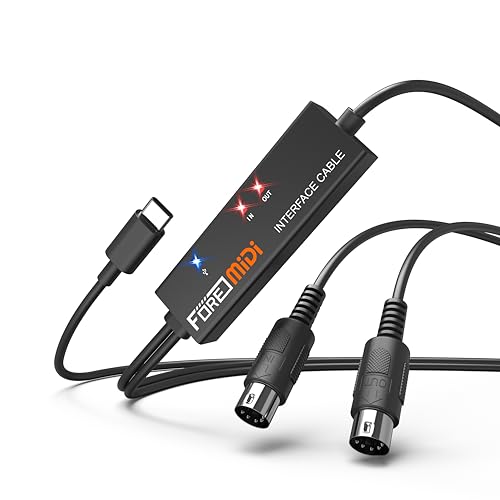
- One MIDI input and one MIDI output
- Plug-and-play USB-C connection
- Works with iOS, Android, Windows, and macOS
Best For: Connecting five-pin MIDI gear to USB-C devices
Best All-Around Studio Hub
Focusrite Scarlett 4i4 4th Gen

- 4-in/4-out design with MIDI I/O
- Two mic preamps and two Hi-Z inputs
- Auto Gain, Clip Safe, and Air mode
Best For: Growing home studios with varied gear
Best Balanced Pick

- USB-C 2-in/2-out interface
- 24-bit/192kHz recording
- Hardware monitoring and iOS support
Best For: Compact home and mobile recording setups
Best Beginner-Friendly Pick
Focusrite Scarlett 2i2 4th Gen

- Two mic preamps and Hi-Z inputs
- Auto Gain and Clip Safe controls
- Includes recording software and plugins
Best For: First home-studio vocal and guitar recordings
Best MIDI-Ready Pick

- Dedicated MIDI I/O and 2-in/2-out audio
- 32-bit/192kHz USB 3.0 support
- DSP monitoring with included effects
Best For: MIDI keyboard and hardware-synth setups
Best Value
- MIDI I/O with two mic and instrument inputs
- Up to 24-bit/96 kHz recording
- Includes a broad recording software bundle
Best For: Budget-conscious home and mobile recording
Best for Simple Setups
- Two combo mic, line, and instrument inputs
- Zero-latency USB/Direct monitoring switch
- Supports recording, podcasting, and streaming
Best For: Entry-level recording and streaming workflows
Best Sound Quality
- Vintage mode emulates UA 610-style preamp character
- Up to 24-bit/192 kHz recording
- Compatible with computers and supported iOS devices
Best For: Solo musicians wanting high-resolution, characterful recording
Best Compact Studio Pick – Arturia MiniFuse 2
The Arturia MiniFuse 2 is a practical audio interface with MIDI ports for musicians who want a compact setup for vocals, guitar, synths, and other instruments. It combines two combo inputs, balanced outputs, headphone monitoring, loopback, and five-pin MIDI connectivity in a beginner-friendly package.
Best For: Home recording, mobile production, and beginners building a MIDI-enabled studio.
Pros:
- Includes five-pin MIDI input and output for synths, controllers, and drum machines.
- Two combo microphone, instrument, and line inputs with 48V phantom power.
- Supports recording up to 192 kHz and includes useful music software.
- Backed by an extensive five-year warranty.
Cons:
- Provides two main inputs and outputs, which may limit larger recording setups.
- USB connectivity may require an adapter depending on the computer port.
The MiniFuse 2 stands out when you want MIDI integration without giving up a straightforward workflow. Its small footprint, loopback feature, included software, and long warranty make it a strong choice for a flexible starter or travel rig.
Best Monitoring-Focused Pick – MOTU M4 4×4 USB-C
The MOTU M4 is an audio interface with MIDI ports designed for recording, mixing, podcasting, and connecting multiple studio devices. Its 4-in/4-out USB-C layout includes two microphone preamps, MIDI I/O, loopback, and hardware monitoring for a versatile desktop setup.
Best For: Musicians, podcasters, and producers who need four-in/four-out routing and low-latency monitoring.
Pros:
- Provides 4-in/4-out USB-C connectivity with MIDI I/O.
- Includes two microphone preamps for vocal and instrument recording.
- Offers hardware monitoring, loopback, and an LCD screen.
- Supports up to 192 kHz and works with Mac, PC, and iOS devices.
Cons:
- Its two microphone preamps may be limiting for larger multi-mic sessions.
- The supplied warranty is two years, shorter than some competing options.
Choose the M4 when flexible routing and monitoring matter as much as MIDI connectivity. The four-in/four-out design is particularly useful for combining microphones, instruments, and external MIDI hardware in one workstation.
Best MIDI-Only Budget Option – FORE T1 USB-C MIDI Interface
The FORE T1 is a simple audio interface with MIDI ports in cable form, intended for connecting five-pin MIDI equipment to a USB-C phone, tablet, or computer. It provides one MIDI input, one MIDI output, plug-and-play operation, LED status indicators, and support for common music software.
Best For: Players who need to connect a keyboard, synthesizer, drum machine, or other five-pin MIDI device to USB-C hardware.
Pros:
- Offers one MIDI input and one MIDI output with 16 MIDI channels.
- Plug-and-play design uses a built-in driver and LED activity indicators.
- Compatible with iOS, Android, Windows, and macOS systems.
- USB bus-powered and supplied with an integrated 6.5-foot cable.
Cons:
- It is a MIDI converter, not a full audio interface with microphone or line inputs.
- A USB A-to-C adapter is not included.
- Designed for one MIDI connection in and one out rather than expanded studio routing.
The T1 makes sense if your priority is MIDI data transfer rather than audio recording. It is an inexpensive, focused solution for adding a five-pin MIDI instrument to a USB-C-based music setup, but it cannot replace a complete audio interface.
Best All-Around Studio Hub – Focusrite Scarlett 4i4 4th Gen
The Focusrite Scarlett 4i4 4th Gen is an audio interface with MIDI ports for producers who need to connect microphones, guitars, synths, drum machines, and line-level equipment. Its 4-in/4-out design adds two microphone preamps, two Hi-Z inputs, four line inputs, four line outputs, and MIDI I/O.
Best For: Home studios that need broad instrument connectivity, reliable level control, and room to expand.
Pros:
- Combines two mic preamps, two Hi-Z inputs, four line inputs, and four line outputs.
- Includes MIDI input and output for external keyboards, synths, and drum machines.
- Air mode, Auto Gain, and Clip Safe support easier recording and level management.
- Offers a 120 dB dynamic range, 192 kHz operation, and a three-year warranty.
Cons:
- At 2.2 pounds, it is less lightweight than the most compact interfaces.
- The larger I/O set may be more than a basic one- or two-input setup requires.
For a growing home studio, the Scarlett 4i4 provides a well-rounded combination of audio and MIDI connectivity. Its expanded line I/O and practical recording aids make it a strong choice when you want one interface to handle several types of gear.
Best Balanced Pick – MOTU M2
The MOTU M2 is a practical audio interface with MIDI ports alternative for creators who need a compact USB-C setup with two inputs and two outputs. It supports 24-bit/192kHz recording, hardware monitoring, and compatibility with macOS, Windows, and iOS.
Best For: Home recording, mobile setups, and musicians who want a straightforward two-channel interface with high-resolution audio.
Pros:
- USB-C connectivity with macOS, Windows, and iOS compatibility
- 24-bit/192kHz recording and 2-in/2-out configuration
- Hardware monitoring for practical low-latency tracking
- Includes 6+GB of free content and a two-year warranty
Cons:
- The supplied specifications do not list dedicated MIDI input or output ports
- Only two channels are available for simultaneous recording
The M2 is a strong compact choice when audio quality and simple monitoring matter most. However, shoppers specifically seeking physical MIDI connectivity should verify their requirements, since MIDI ports are not listed in the supplied specifications.
Best Beginner-Friendly Pick – Focusrite Scarlett 2i2 4th Gen
The Focusrite Scarlett 2i2 4th Gen is a user-friendly audio interface with MIDI ports comparison option for recording vocals and instruments. Its two mic preamps, two Hi-Z inputs, 120dB dynamic range, and USB connectivity suit a wide range of home-studio workflows.
Best For: Beginners and home producers recording microphones or guitars who want automatic level control and a broad software bundle.
Pros:
- Two mic preamps and two Hi-Z instrument inputs
- 24-bit/192kHz operation with a stated 120dB dynamic range
- Auto Gain and Clip Safe features help manage recording levels
- Includes Air modes, Ableton Live Lite, Cubase LE, Pro Tools Intro+, and Hitmaker Expansion
Cons:
- The supplied specifications do not list dedicated MIDI input or output ports
- Its two-channel design is intended for smaller recording sessions
The 2i2 4th Gen emphasizes accessible recording rather than extensive hardware expansion. It is compelling for vocals, guitar, and software-based production, but users shopping specifically for an audio interface with MIDI ports should confirm that external MIDI hardware is supported through their intended setup.
Best MIDI-Ready Pick – Yamaha URX22C
The Yamaha URX22C is the clearest fit for shoppers seeking an audio interface with MIDI ports, combining MIDI I/O with two analog inputs and outputs. It also adds 32-bit/192kHz USB 3.0 audio, DSP-powered monitoring, and included Steinberg software for a flexible studio setup.
Best For: Musicians using MIDI keyboards or other MIDI equipment alongside microphones, instruments, and software-based production.
Pros:
- Provides both MIDI I/O and 2-in/2-out analog connectivity
- Two XLR/TRS combo inputs with Class-A D-PRE preamps and +48V phantom power
- Includes one Hi-Z input and two TRS main outputs
- DSP monitoring includes REV-X reverb, Channel Strip, and Guitar Amp Classics
Cons:
- One-year manufacturer warranty is shorter than some competing options listed here
- The supplied warranty applies to purchases from authorized Yamaha retailers in the stated U.S. coverage area
- Its two-channel layout may not suit larger tracking sessions
With dedicated MIDI I/O, the URX22C directly addresses a key requirement for hardware-synth and controller users. Its durable full-metal housing, DSP effects, and cross-platform support make it a versatile choice for a compact MIDI-equipped studio.
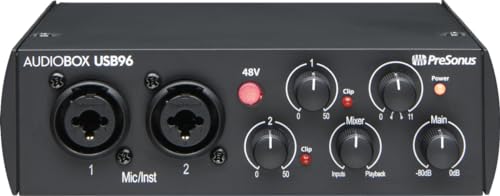
Best Value – PreSonus AudioBox 96
If you want an audio interface with MIDI ports for personal recording, the PreSonus AudioBox 96 offers a practical two-channel setup with MIDI I/O, two mic preamps, instrument inputs, and bus-powered portability. It also supports recording and playback up to 24-bit/96 kHz.
Best For: Home recordists, mobile musicians, and beginners who want MIDI connectivity plus a useful software bundle.
Pros:
- Includes MIDI I/O alongside two mic preamps and two instrument inputs.
- Supports up to 24-bit/96 kHz recording and playback.
- USB bus power, zero-latency mixer control, and global 48V phantom power suit portable setups.
- Includes Studio One Artist, Ableton Live Lite, and the Studio Magic Plug-In suite.
Cons:
- Only two input channels are available.
- Phantom power is global rather than independently switchable per channel.
The AudioBox 96 is a strong value choice when MIDI hardware support and included recording software matter as much as basic audio capture. Its compact, bus-powered design also makes it easy to move between a desk and a mobile setup.
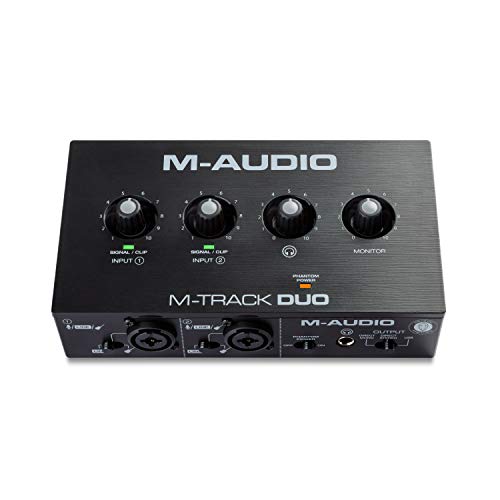
Best for Simple Setups – M-AUDIO M-Track Duo
The M-AUDIO M-Track Duo is a straightforward audio interface with MIDI ports for users who need a compact two-channel USB sound card for recording, podcasting, or live streaming. Its combo inputs accept microphones, instruments, or line-level sources, with 48 kHz recording resolution.
Best For: Beginners, podcasters, streamers, and musicians who need flexible inputs and uncomplicated monitoring.
Pros:
- Two combo XLR/line/instrument inputs accommodate varied sources.
- USB/Direct switching provides zero-latency monitoring.
- Includes 48 kHz audio resolution and phantom power for condenser microphones.
- Comes with MPC Beats and supports Mac, PC, iOS, and Android devices.
Cons:
- Maximum sample rate is 48 kHz.
- The supplied notes do not list dedicated MIDI I/O specifications.
Choose the M-Track Duo if ease of use and flexible analog inputs are your priorities. It works well for basic recording and streaming, but shoppers specifically needing physical MIDI ports should verify the connection layout before buying.
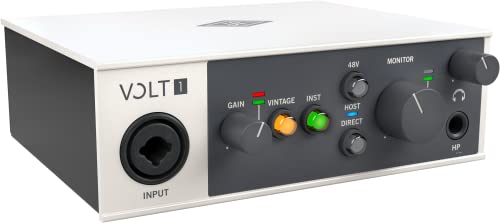
Best Sound Quality – Universal Audio Volt 1
For musicians seeking an audio interface with MIDI ports and a more characterful preamp option, the Universal Audio Volt 1 combines Vintage mode, 24-bit/192 kHz conversion, and support for MIDI devices. It is a compact one-channel interface for desktop or mobile recording.
Best For: Solo musicians and producers who prioritize high-resolution capture and a vintage-style preamp sound.
Pros:
- Vintage mode is designed to provide the sound of UA’s classic 610 preamps.
- Supports recording quality up to 24-bit/192 kHz.
- Works with Mac, Windows, iPad, and iPhone setups.
- Includes access to LUNA and additional music-production tools and plug-ins.
Cons:
- Provides one input channel, limiting simultaneous recording.
- Mobile use requires an external Volt power supply and, where applicable, an Apple Lightning to USB Camera Adapter.
The Volt 1 is appealing for solo recording when preamp character and high-resolution audio matter more than input count. Its stated MIDI-device compatibility adds flexibility, while the single-channel design keeps the unit focused and compact.
How We Picked the Best Audio Interface with Midi Ports
We focused on interfaces that support practical home-recording and music-production workflows, with particular attention to MIDI input and output, computer connectivity, microphone preamps, instrument inputs, headphone monitoring, and driver or software support. We also considered how well each model fits its intended user, from beginners who need a simple setup to producers who require more inputs and hardware integration.
Not every product is designed for the same role. Some are compact two-channel interfaces, while others provide additional inputs, loopback features, onboard processing, or expanded routing. The right choice depends on how many sources you record at once and which MIDI devices you plan to connect.
Quick Comparison
- Best overall flexibility: Look for four-input models with dedicated MIDI I/O and multiple monitoring options.
- Best for beginners: Choose a straightforward two-input interface with simple controls and bundled recording software.
- Best for portable setups: Prioritize USB-C connectivity, compact dimensions, bus power, and a sturdy enclosure.
- Best for hardware-heavy production: Select an interface with reliable MIDI timing, physical MIDI ports, and enough analog inputs for synthesizers, drum machines, or external effects.
Key Buying Factors for an Audio Interface with Midi Ports
MIDI Connectivity
Confirm that the interface includes the MIDI connections you need. Standard five-pin MIDI In and Out are useful for keyboards, older synthesizers, drum machines, and controllers. USB MIDI may be sufficient for newer devices, but it does not replace traditional ports when connecting external hardware directly.
Inputs and Recording Capacity
Two inputs work well for vocals, guitar, stereo keyboards, or basic overdubbing. Four or more inputs are a better fit for recording multiple microphones, stereo hardware, or a small ensemble. Check whether combo inputs accept both XLR microphones and quarter-inch line or instrument cables.
Audio Quality and Monitoring
Higher sample-rate support can be useful for specific production workflows, but clean preamps, low-latency monitoring, and dependable drivers matter more in everyday use. A direct-monitoring control or well-designed software mixer can help you record without distracting delay.
Power, Compatibility, and Software
USB bus power makes a compact interface easier to use with laptops, while some setups may benefit from an external power supply. Verify operating-system compatibility and review the included software, especially if you are building a studio from scratch.
Who Should Buy Which Audio Interface with Midi Ports?
Choose a compact two-channel model if you mainly record one or two sources at a time, need a portable interface, or want an uncomplicated entry point. Choose a four-channel interface if you use multiple synthesizers, record stereo sources, or want more room to expand without replacing the interface.
Choose a model with onboard DSP or advanced routing if low-latency effects, flexible monitoring, or streaming workflows are priorities. Choose the simplest affordable option if you only need basic microphone, instrument, and MIDI connectivity for occasional recording. Before buying, map your current equipment and count every input, output, and MIDI connection you expect to use; a small amount of extra capacity can prevent an expensive upgrade later.